The first month of school tells teachers a lot about their students. During those first few weeks, we learn who reads fluently, who struggles with math facts, who makes friends easily, and who may need additional support. We also begin noticing classroom behaviors that concern us. Some students blurt out answers, struggle to stay seated, or become frustrated when work is difficult. These challenges are often easy to recognize because they disrupt instruction or draw immediate attention.
Other executive function problems are much quieter.
These students may not stand out during the school day. They are often polite, cooperative, and genuinely trying their best. Yet they constantly seem to be behind. They forget materials, lose assignments, underestimate how long tasks will take, struggle to get started, or need directions repeated multiple times. Teachers may find themselves thinking, “We’ve talked about this so many times. Why is this still happening?”
Sometimes these patterns are mistaken for laziness, carelessness, lack of motivation, or poor effort. In reality, many of these students are demonstrating executive function problems.
Executive function skills are the mental processes that help us plan, organize, manage time, control impulses, regulate emotions, remember information, and follow through on tasks. When executive function skills are weak, students often know what they should do but struggle to consistently do it. They may understand expectations, want to be successful, and still have difficulty meeting those expectations without additional support.
One of the biggest mistakes educators make is assuming that executive functioning concerns only affect students with ADHD or students receiving special education services. While executive function difficulties are common in students with ADHD, many general education students also struggle with executive function skills. They may not need an IEP, but they often benefit from explicit instruction, accommodations, and executive functioning strategies that help them become more independent.
The first month of school provides valuable opportunities to identify these concerns before they become larger academic, behavioral, or organizational problems.
Here are some executive function red flags teachers should watch for.

One of the executive function red flags teachers frequently miss during the first month of school involves planning and time management.
These students often seem confident that everything will get done eventually. They may postpone starting assignments, put off long-term projects, or spend valuable work time focusing on less important tasks. When teachers check in, the student often appears unconcerned because they genuinely believe there will be plenty of time later.
Unfortunately, later has a way of arriving quickly.
As deadlines approach, these students frequently become overwhelmed. Work that could have been completed over several days now has to be finished all at once. Projects are rushed. Important details are forgotten. The quality of the work often suffers even when the student is capable of producing much better results.
What adults sometimes interpret as laziness or procrastination may actually be a weakness in executive functioning skills related to planning, prioritizing, and time management.
This is one reason executive function planning deserves attention early in the school year. Students who struggle in this area often benefit from explicit instruction in breaking large tasks into smaller steps, estimating how long assignments will take, using checklists, and monitoring their progress over time.
Without those supports, many students continue repeating the same cycle of falling behind, feeling overwhelmed, and disappointing themselves.

Another common red flag involves organization. Every teacher has had students who seem to spend half their day searching for things. They can’t find their pencil, their homework, their folder, or the paper they were using five minutes ago. Their desk may be overflowing, their backpack may be stuffed with crumpled papers, and they often seem surprised when important materials cannot be located.
Because these students are frequently bright and capable, adults sometimes assume they simply need to “try harder” to stay organized. The reality is that organization is an executive functioning skill. Students are not born knowing how to create systems, maintain systems, and use those systems consistently.
These difficulties often extend beyond the classroom. Parents may describe bedrooms covered in clothes, toys, books, and papers despite repeated reminders to clean them. Favorite belongings seem to disappear regularly, and students may spend large amounts of time searching for items they just had a few minutes earlier. While every child can be messy occasionally, persistent difficulties keeping track of materials across multiple environments may be a sign that organization is an executive functioning skill area that needs support.
Like any other skill, organization often requires direct instruction, modeling, and practice. The first month of school is an excellent time to identify these concerns because classroom routines are still being established. Students who consistently struggle to keep track of materials during September often continue experiencing those same difficulties throughout the year unless they are taught strategies to manage them.
For some students, simple organizational supports are enough. Others may require more targeted executive functioning interventions that address the underlying skill deficit rather than simply the visible behavior.

One of the most misunderstood executive function problems involves working memory.
Teachers often give a set of directions, watch the student nod in understanding, and then wonder why the task was never completed. From the teacher’s perspective, it appears that the student either wasn’t listening or chose not to follow directions. In reality, many students fully understand the directions when they hear them. The difficulty comes later when they are expected to remember and manage multiple pieces of information while completing the task.
These students often lose track of steps, forget what they were supposed to do next, or become distracted before completing the assignment. As a result, they may appear inattentive even when they were paying attention initially.
This is one reason distracted children in the classroom are not always struggling with attention alone. Sometimes the underlying issue involves working memory, task management, or other executive functioning skills that make it difficult to follow through successfully.
Teachers who recognize this pattern early can often help students by providing written directions, visual reminders, checklists, and structured routines that reduce the demands placed on working memory.

Some students have no trouble getting started. In fact, they may begin every assignment with enthusiasm. The problem is that they rarely seem to finish what they start. Independent work sits half-completed. Long-term projects remain unfinished. Tasks that should take twenty minutes somehow stretch across multiple days.
Teachers sometimes assume these students lack motivation or simply don’t care enough to follow through. In many cases, however, the issue is not motivation at all. Students may struggle with persistence, task initiation, self-monitoring, or self-motivation. They often begin with good intentions but have difficulty sustaining effort once the task becomes challenging, repetitive, or less interesting.
This is where executive functioning skills become especially important. Success in school requires more than intelligence or academic ability. Students must be able to manage themselves long enough to complete the work, even when they would rather be doing something else.
When teachers notice this pattern early, they can begin teaching strategies such as breaking assignments into smaller chunks, setting intermediate deadlines, and providing regular check-ins. These supports help students experience success while gradually building independence.

Another executive function red flag appears in students who seem determined to finish before anyone else. These students often complete assignments quickly but make mistakes they know how to avoid. They skip punctuation, overlook directions, miss details, and turn in work that doesn’t reflect their actual ability. When teachers review the assignment with them, students can frequently identify and correct the errors almost immediately.
The challenge isn’t knowledge. The challenge is self-monitoring. These students are often so focused on being finished that they fail to evaluate the quality of their work before moving on. What adults see is careless work. What may actually be happening is a weakness in executive functioning skills related to attention, self-awareness, and self-monitoring.
One reason this red flag is important to recognize early is that the gap between ability and performance tends to grow over time. As assignments become longer and more complex, students who rush frequently produce work that falls far below what they are truly capable of doing. Teaching students to slow down, review their work, and develop checking routines can have a significant impact on both academic performance and confidence.

When teachers think about executive function problems, this is often the student who comes to mind first. The student begins working but quickly becomes distracted by conversations, sounds, movement, materials on their desk, or thoughts in their own head. Directions are forgotten. Assignments remain unfinished. Independent work requires constant redirection.
Because these behaviors are often visible, distracted children in the classroom tend to receive attention much earlier than students with planning or organization difficulties. The challenge is that distraction can stem from several different executive function areas.
Sometimes attention itself is the primary concern. Other times the difficulty involves working memory, task management, organization, or self-monitoring. This is why it is important not to assume that all distracted behavior has the same cause.
Teachers often ask how to help a distracted child, but the answer depends on why the student is struggling in the first place. A child distracted in the classroom because they cannot keep track of multiple steps may need very different supports than a student who becomes distracted because they struggle to sustain attention during independent work.
This is one reason effective executive functioning strategies begin with identifying the underlying skill deficit. Once teachers understand what is causing the difficulty, interventions become much more targeted and effective.

Some executive function red flags affect relationships more than academics. These students blurt out answers, interrupt conversations, make impulsive comments, or react emotionally before thinking through the consequences of their actions. Teachers often hear apologies such as, “I don’t know why I said that,” or “I wasn’t thinking.”
Many times, those statements are surprisingly accurate.
Students who struggle with inhibition and impulse control frequently react before considering potential outcomes. This can create academic difficulties, social conflicts, and behavioral concerns even when the student understands classroom expectations. Because these behaviors are often disruptive, they tend to receive attention quickly. However, identifying the behavior is only the first step. Students also need explicit instruction in pausing, reflecting, and considering the likely consequences of their actions before responding.
Just as we teach reading and math skills directly, executive functioning skills related to self-control and inhibition often require direct instruction, practice, and feedback.

One of the biggest mistakes educators make is treating executive functioning as a single skill. A student who struggles with planning may need very different supports than a student who struggles with working memory. Likewise, a student who struggles with organization may require different interventions than a student who struggles with attention or emotional regulation.
This is why identifying the specific executive function area is so important.
When teachers move beyond general observations such as “disorganized,” “unmotivated,” or “distracted,” they are better able to select effective executive functioning interventions and executive functioning accommodations that address the actual problem.
For example:
Although the behaviors may look similar on the surface, the underlying needs can be very different.

This is one reason I created my Executive Functioning Skills Checklists.
Many teachers recognize that a student is struggling but have difficulty determining exactly why. A student who appears disorganized may actually be struggling with planning. A student who seems distracted may be having difficulty with working memory. Another student may be experiencing challenges with self-monitoring, persistence, or emotional control.
The checklists function as both an executive function assessment and an executive function checklist, helping educators identify specific strengths and areas of need rather than relying on guesswork.
Rather than simply identifying that a student struggles with planning, attention, or organization, the checklists break each executive function area into specific observable subskills. This makes it easier to identify exactly where a student is struggling and select interventions, accommodations, and goals that address the underlying skill deficit rather than just the visible behavior.
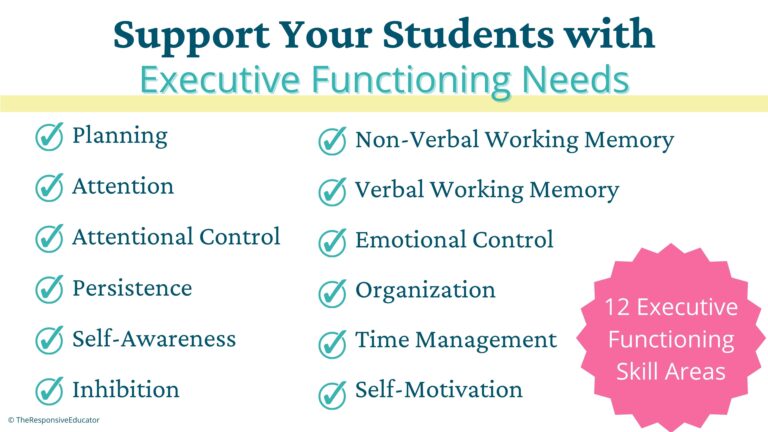
Each checklist examines multiple executive function areas, including planning, attention, attentional control, persistence, time management, emotional control, organization, self-awareness, inhibition, working memory, and self-motivation. The checklists assess both commonly recognized executive functioning skills and less obvious areas that can significantly impact student success.
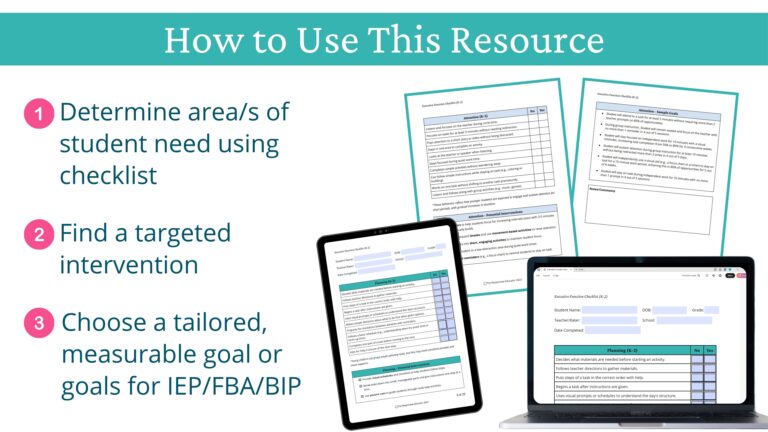
The checklists also include executive functioning interventions, executive functioning accommodations, sample executive functioning goals, and executive functioning IEP goals. They can be used when developing classroom interventions, supporting an FBA, creating a BIP, writing IEP goals, or identifying targeted supports for students who need additional help.
One feature teachers particularly appreciate is that the checklists are organized by age level. Executive function skills by age look very different in kindergarten than they do in middle school or high school. Separate versions are available for K-2, 3-5, 6-8, and 9-12, allowing educators to evaluate students using developmentally appropriate expectations.
Whether you’re supporting a student with ADHD, developing a behavior plan, writing IEP goals, or simply trying to better understand why a student is struggling, having a structured executive functioning checklist can help turn observations into actionable next steps.
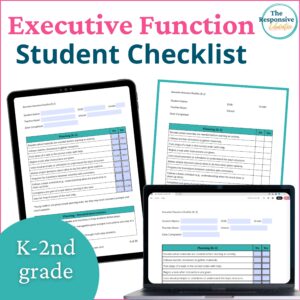
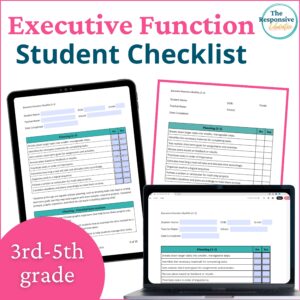
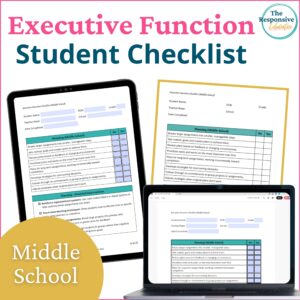
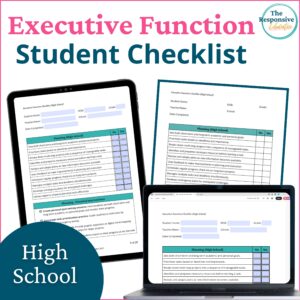
Each executive function area includes observable subskills, targeted interventions, sample goals, and developmental guidance. Rather than stopping at identifying a concern, educators can use the information to develop more targeted supports and create a clear plan for helping students build executive functioning skills over time.
The first month of school provides teachers with far more information than most people realize. While academics are important, many of the patterns that emerge during those first few weeks involve executive functioning skills. Students reveal how they manage time, organize materials, follow directions, control impulses, sustain attention, and persist through challenges.
Some of these red flags are loud and obvious. Others are quiet and easy to overlook.
The students who struggle with planning, organization, time management, and follow-through are not always the students who disrupt class. In fact, many are working incredibly hard while quietly falling further behind.
When teachers learn to recognize these executive function red flags early, they can provide targeted supports before small struggles become larger academic, behavioral, or emotional challenges. Identifying the underlying skill deficit is often the first step toward helping students become more successful, independent, and confident learners.
Stories can help students recognize executive functioning challenges in characters—and begin talking about the strategies that might help. These executive function books for kids provide useful starting points for conversations about planning, organization, attention, flexibility, and self-control.


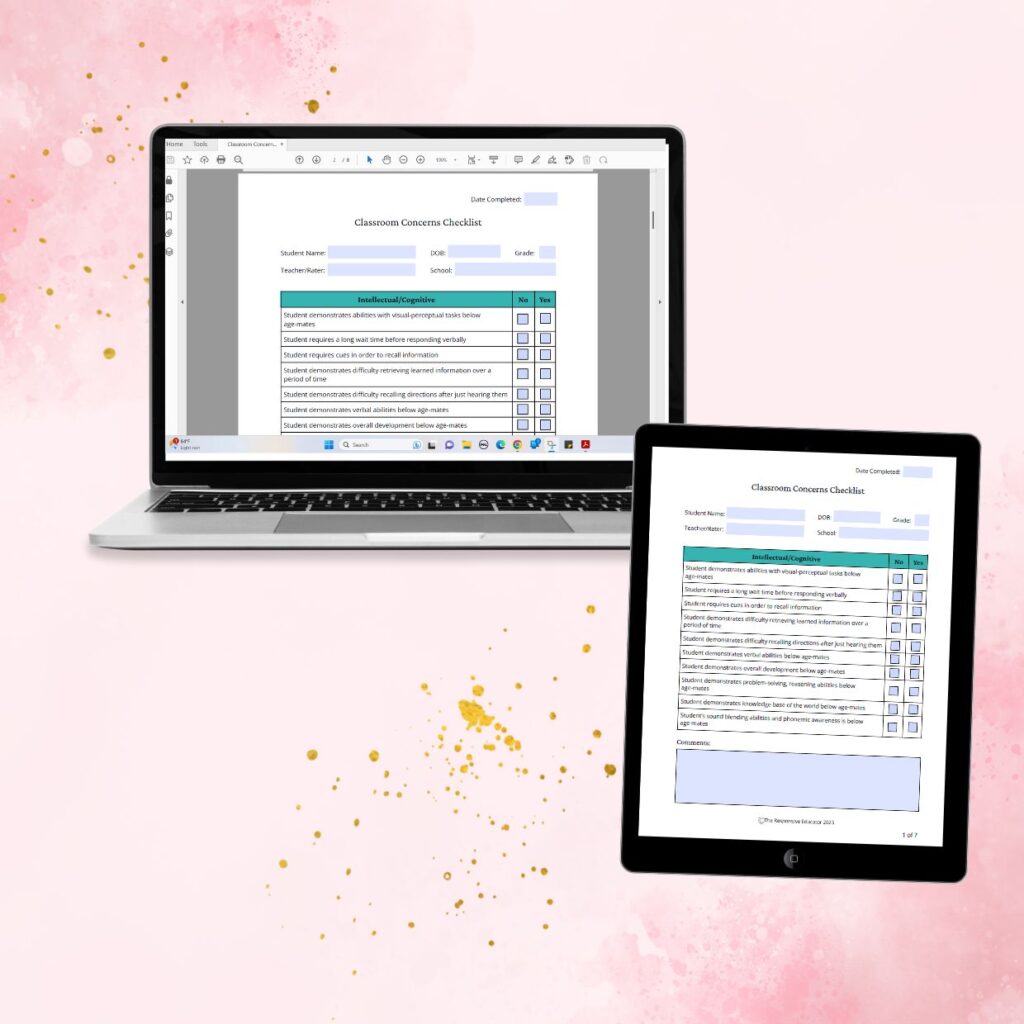
Support your students’ individual needs with our exclusive Classroom Concerns Checklist. Identify patterns in areas like cognitive skills, communication, social/emotional behavior, and more.
Sign up now to receive instant access and valuable insights on addressing classroom concerns.

Support your students’ individual needs with our exclusive Classroom Concerns Checklist.
Identify key concerns in areas like:
…and more to help drive collaboration and problem-solving.
Sign up now to receive instant access and valuable insights on addressing classroom concerns.