Have you ever explained an assignment, answered a few questions from the class, and then noticed one student quietly staring at a blank paper? They are not writing, looking at their notes, or raising their hand. They simply sit there, hoping the assignment will somehow become easier if they wait long enough.
When you finally walk over, the student quietly says, “I don’t get it.” You ask what they need help with, and they shrug or gesture vaguely toward the entire worksheet. If you have spent any time in a classroom, you have probably worked with students like this.
Some children rarely ask for help, even when they desperately need it. Others ask almost immediately, before they have read the directions or attempted the first step. Both patterns interfere with learning, but they often come from very different underlying needs and should not automatically receive the same response.
As teachers, it can be tempting to focus on getting students through today’s assignment. We explain the directions again, point them toward the answer, or work through the problem with them so they can move on. While those responses may solve the immediate problem, they do not always teach the skill the student is missing.
Knowing when to ask for help, how to explain what you need, and how to use support without expecting someone else to do the thinking are all learned skills. Like reading, organization, or conflict resolution, help-seeking must be taught, modeled, practiced, and reinforced.
Disclosure: As an Amazon Associate, I earn from qualifying purchases. If you purchase a book through the links below, I may earn a small commission at no additional cost to you. Thank you for supporting The Responsive Educator!

Many students believe asking for help means they are not smart enough. They assume everyone else understands and they are the only one struggling. Some are naturally shy and do not want to draw attention to themselves, while others have learned to treat mistakes as something to hide rather than an expected part of learning.
I have worked with many perfectionistic students who believed they should be able to complete every assignment independently. If they did not understand something immediately, they assumed they simply were not capable of learning it. I would often ask, “If you already knew everything I was trying to teach you, why would you need to come to school?” Usually, that made them stop and think.
The purpose of school is not to prove that we already know everything. The purpose of school is to learn something new, and learning always begins with what we understand today before taking the next step. Needing another example, a different explanation, or some guided practice is completely normal when we are learning an unfamiliar skill.
Teachers use help all the time. We read professional books, learn new technology, collaborate with colleagues, attend training, and ask questions when someone else understands something better than we do. We do not view that as weakness. We view it as professional growth. Students deserve to understand that learning works exactly the same way for them.
True independence does not mean never needing help. It means recognizing when you can solve a problem on your own, when you should try another strategy, and when another person or resource can help you continue. Those are life skills that extend far beyond the classroom.

Although the behavior may look the same on the surface, students avoid asking for help for many different reasons. Understanding the likely cause helps us respond with empathy while still teaching the student how to become a more independent learner.
The goal is not to excuse the behavior or leave a student sitting in front of a blank page. The goal is to choose an instructional response that matches the skill the student actually needs to develop.
For many children, asking a question feels risky. They worry that everyone else already understands, do not want classmates to think they are not smart, or feel uncomfortable becoming the center of attention. If they have been embarrassed after asking a question in the past, that hesitation often becomes even stronger.
From the teacher’s perspective, these students may appear disengaged. In reality, embarrassment, anxiety, or self-consciousness may make asking for help feel harder than the assignment itself. A classroom where mistakes are discussed as useful information instead of evidence of failure makes it much safer for students to admit when they are confused.
Some students do not avoid asking for help because they do not care. They avoid asking because they care so much about being correct that they would rather not begin than risk making a mistake. If they cannot do something correctly the first time, they may interpret the struggle as proof that they are incapable of learning it.
These students need more than reassurance that everything will be easy. They need repeated experiences showing that confusion is not evidence they cannot learn—it is evidence that they are learning something new. Sometimes another explanation, a different example, or a new way of looking at the problem is exactly what allows learning to click.
One of the biggest misconceptions adults have is assuming students always know what they need help with. Many do not.
When a teacher asks, “What do you need help with?” a student may genuinely have no idea how to answer because the entire task feels confusing. They may not know whether they misunderstood the directions, forgot a previously taught skill, missed an important vocabulary word, or simply do not know where to begin.
In those situations, “I don’t get any of it” may be an honest description rather than an attempt to avoid thinking. These students often need help breaking the task into smaller pieces and identifying the first point where their understanding begins to fall apart.
Students also learn from the way adults respond to their questions. If asking for help regularly leads to impatience, public correction, or an explanation delivered with visible frustration, students may decide that remaining quiet is the safer choice. The adult may not intend to discourage questions, but students respond to the interaction they experienced, not the intention behind it.
When asking for help consistently feels safe, students become more willing to speak up. When it feels embarrassing or inconvenient, many quietly stop asking. That does not mean teachers should provide unlimited individual attention whenever a student asks. It means our response should communicate that confusion is a normal part of learning and that we will help students take the next productive step.
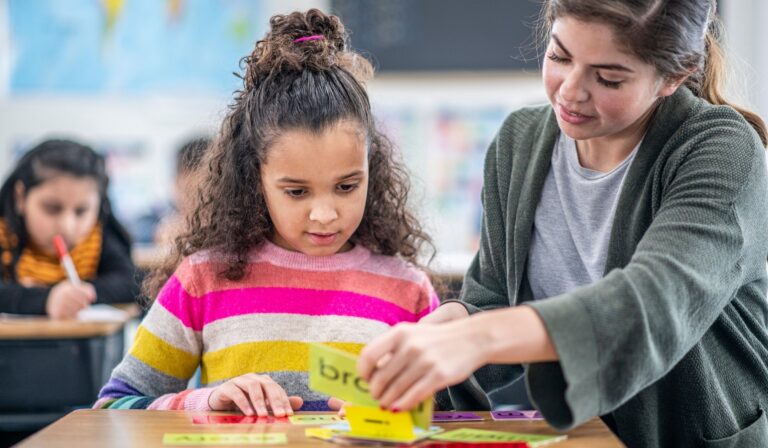
Not every help-seeking problem looks like silence. Some students raise their hands within seconds of receiving an assignment. Before they have read the directions, looked at an example, or attempted the first question, they are already saying, “I don’t know how to do it.” When asked what part is confusing or what they have already tried, they gesture toward the entire page and reply, “All of it.”
It can be tempting to assume these students are lazy or refusing to work. Sometimes that may be true, but we should be careful not to make it our first conclusion. More often, something else is happening underneath the behavior, and identifying that difference changes the type of support the student actually needs.
Some students become overwhelmed when they see an entire page of work and struggle to break it into smaller, manageable steps. They may have difficulty organizing their thinking, initiating the task, monitoring their progress, or explaining exactly where they became confused. In these situations, the immediate challenge is not always the academic skill being taught. Sometimes it is executive functioning.
Even an assignment a student is academically capable of completing can feel impossible when they cannot identify how to begin. Instead of seeing a sequence of manageable steps, they see one enormous task. Identifying the executive functioning skill involved allows us to teach a useful strategy instead of simply providing more adult assistance.
Other students have learned a different pattern. Over time, they discover that if they wait, appear unsure, or ask a vague question, an adult will eventually sit beside them, read every direction, make the decisions, and guide them through each answer. People naturally repeat behaviors that have worked in the past, and children are no different.
This does not require us to label a child as manipulative. It requires us to honestly examine what the classroom system has been teaching. If waiting consistently leads to an adult doing most of the thinking, the assignment may get completed while the student receives very little practice with persistence, decision-making, or problem-solving.
One of the biggest mistakes we can make is assuming every struggling student needs the same type of support. Some students need encouragement to keep trying. Others need support to begin trying. Those are two very different situations.
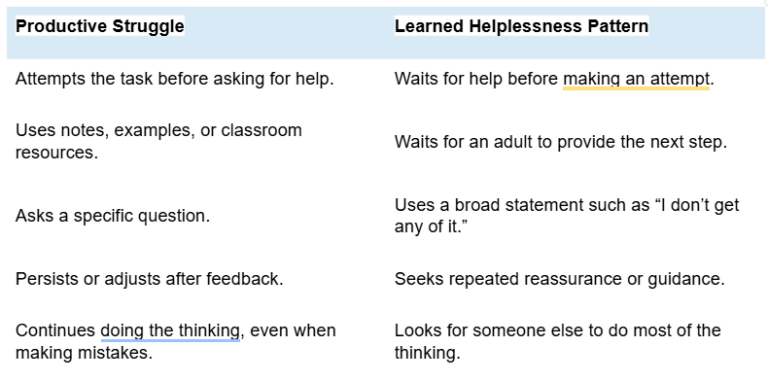
Understanding the difference between productive struggle and learned helplessness is important because the teaching response is very different.
When students are engaged in productive struggle, they are actively thinking. They may try different strategies, reread directions, use classroom resources, or ask specific questions when they become stuck. They are doing the cognitive work of learning, even if they have not found the correct answer yet. In these situations, stepping in too quickly can actually prevent students from developing perseverance and problem-solving skills.
Students demonstrating learned helplessness often show a different pattern. Rather than attempting the task, they immediately look to an adult to solve the problem for them. They may not read the directions, use available resources, or attempt even the first step before asking for help. Over time, they begin to believe they cannot succeed without someone else doing much of the thinking.
The goal is not to leave either group struggling on their own. Instead, we want to provide the type of support that helps each student become more independent. Some students need encouragement to keep working through an appropriate challenge. Others need instruction in how to begin working before seeking assistance. Recognizing the difference allows us to teach the underlying skill instead of simply helping students finish today’s assignment.

Even when our intentions are good, some of our responses can unintentionally make it harder for students to develop healthy help-seeking habits. Most teachers have used these approaches at one time or another because we are trying to keep instruction moving and support everyone in the room. Taking a closer look at our own responses can help us create classroom routines that encourage students to think more independently while still feeling comfortable asking for help when they genuinely need it.
One of the biggest assumptions we make is believing that students naturally know how to ask for help. We often expect them to recognize exactly where they became confused, explain their thinking clearly, and ask a specific question.
For many students, that is a complex skill. They may only know that something feels confusing. They may not yet have the vocabulary or self-awareness to identify exactly where they became stuck. Instead of expecting students to already have this skill, we need to teach it just as intentionally as we teach academic content.
When we see a student struggling, it is natural to want to help immediately. After all, no teacher enjoys watching a child become frustrated.
However, solving the problem too quickly can unintentionally send the message that persistence is unnecessary because an adult will eventually provide the answer. Over time, students may begin waiting for help instead of attempting to solve manageable problems on their own.
One question I often ask myself is:
“How do I help the student without doing the thinking for them?”
There is an important difference between providing support and removing the productive thinking that leads to learning.
Teachers often praise students for working independently, and independence is certainly an important goal. However, students also need to hear that asking for help appropriately is a strength rather than a weakness.
When we only recognize students who complete everything on their own, some children begin believing that needing help means they have somehow failed. Instead, we can reinforce thoughtful help-seeking by acknowledging when students have tried appropriate strategies, identified where they became confused, and asked specific questions that move their learning forward.
Students pay close attention to how adults respond when they ask questions. If the response sounds rushed, impatient, or dismissive, students often become less willing to ask again.
Most teachers have days when they are juggling multiple demands, but even small changes in our responses can make a difference. A calm acknowledgment such as, “I’m glad you let me know where you got stuck. Let me finish helping this group, and then we’ll figure it out together,” communicates that questions are welcome while still setting reasonable expectations.
“What have you tried?” can be an excellent question, but only when it is asked with genuine curiosity.
If students hear it as a challenge or a way of proving they have not worked hard enough, they may become reluctant to ask questions in the future. Instead, use the question to gather information about the student’s thinking. Their answer tells you whether they need encouragement to persist, instruction in problem-solving, or clarification about the assignment itself.

Once we understand why students struggle to ask for help, we can begin teaching the skill directly. Like any academic or social-emotional skill, effective help-seeking develops through explicit instruction, modeling, guided practice, and feedback over time. The goal is not simply to increase the number of questions students ask. The goal is to help students recognize when they need support, communicate that need effectively, and continue taking ownership of their learning.
Many teachers wait until students are already overwhelmed before discussing how to ask for help. Instead, teach the process proactively while students are calm and ready to learn.
Explain what students should do if they become confused, how they can communicate where they are stuck, and what information will help you provide meaningful support. When expectations are taught ahead of time, students are much more likely to use them during difficult moments.
Students benefit from seeing adults ask for help appropriately. During instruction, think aloud about your own learning process. For example, you might say, “I’m not sure which strategy will work best here. Let me look back at my notes,” or “I’m going to ask another teacher because she has more experience with this than I do.” These simple examples show students that capable learners continue asking questions throughout their lives.
Many students need explicit instruction in how to ask questions that help others understand what they need.
Rather than simply saying, “I don’t get it,” teach students to explain where they became confused.
For example:
These types of questions make it much easier for teachers to identify the next instructional step while helping students become more aware of their own thinking.
Many students benefit from having a simple routine that helps them determine what to do before asking for help. Instead of expecting them to figure it out independently, teach a consistent process that becomes part of your classroom expectations.
For example, students might learn to:
The goal is not to make students jump through hoops before they can receive support. Instead, the routine helps them develop problem-solving habits while giving them confidence that they have already taken meaningful steps on their own.
When a student says, “I don’t get any of it,” the entire assignment often feels overwhelming. Instead of trying to reteach everything immediately, help the student narrow the problem down.
I often ask questions such as:
Breaking a large problem into a much smaller one makes it easier for both the teacher and the student to identify the next instructional step. Over time, students begin asking themselves these same questions, which is exactly the type of self-monitoring we want to develop.
Many students assume that asking the teacher is the only appropriate way to get assistance. While teachers certainly play an important role, independent learners know how to use a variety of resources before relying entirely on an adult.
Teach students when it is appropriate to:
The goal is not to discourage students from asking the teacher for help. Rather, it is to help them build a toolbox of strategies they can use in school and throughout life whenever they encounter something they do not immediately understand.
Just as we reinforce academic skills, we should also notice and encourage effective help-seeking behaviors. Rather than simply praising students for getting the correct answer, acknowledge the process they used to get there.
You might say:
“I noticed you reread the directions before asking your question.”
“You explained exactly where you became confused. That made it much easier for us to figure out the next step.”
“You tried two different strategies before asking for help. That’s exactly what successful learners do.”
Comments like these reinforce that asking for help thoughtfully is part of becoming an independent learner, not the opposite of it.

Students become more confident asking for help when they have opportunities to practice before they are overwhelmed. The following activities help students learn the skill in low-pressure situations so they are more likely to use it during authentic academic challenges.
Present students with short scenarios describing common classroom situations.
For example:
“Jordan has been staring at the same math problem for five minutes but hasn’t asked for help.”
“Ava doesn’t understand one word in the directions and decides to skip the assignment instead.”
“Marcus immediately raises his hand before reading the directions.”
Ask students to discuss questions such as:
Because students are talking about fictional situations rather than themselves, they often feel more comfortable discussing effective strategies honestly.
One of the simplest ways to teach help-seeking is to model it naturally throughout the day. As you solve problems, intentionally verbalize your thinking.
For example:
“I’m not sure which strategy will work best here. Let me look back at yesterday’s example.”
“I don’t remember exactly how this works, so I’m going to check my notes before I ask someone else.”
“I know part of the answer, but I’m confused about this one step. That’s what I need help understanding.”
These moments demonstrate that successful learners continually evaluate what they know, identify what they need, and seek information appropriately.
Reflection helps students become more aware of their own learning habits.
At the end of an assignment or lesson, invite students to think about questions such as:
These short reflections help students recognize patterns in their own behavior and gradually build stronger self-awareness.
Picture books provide a safe way for students to explore challenging situations without feeling personally criticized. Discussing a character’s choices allows students to think about difficult situations objectively before connecting those lessons to their own experiences.
If you’re looking for books to support this skill, I recommend starting with Back to Front and Upside Down by Claire Alexander. In the story, Stan becomes frustrated with his writing but eventually learns that asking for help is part of learning, not a sign of failure. It’s an excellent conversation starter for students who are hesitant to admit they are struggling.
As you read, pause to discuss questions such as:
If you’re looking for additional titles, I’ve also put together a collection of my favorite picture books for teaching children how to ask for help, along with summaries, discussion ideas, and recommendations for different classroom situations. You can find that post here.

Even with proactive instruction, there will be times when students become overwhelmed before they ask for help. They may put their head down, stare at a blank page, insist they cannot do the work, or refuse to begin altogether.
When this happens, our first instinct is often to explain the assignment again or walk the student through every step. While that may get today’s work completed, it doesn’t necessarily teach the student how to respond differently the next time they feel overwhelmed.
Instead, begin by helping the student identify where the learning process broke down. You might ask:
These questions shift the conversation away from “I can’t do any of it” and toward identifying a specific starting point. Once students can recognize exactly where they became confused, they are much more likely to ask focused questions in the future instead of feeling overwhelmed by the entire assignment.
Whenever possible, avoid taking over the task completely. Provide enough support to help students move forward while still allowing them to experience the success of solving the problem themselves. That balance builds both confidence and independence.
It is also important to remember that shutting down is not always an act of defiance. Sometimes it is a sign that a student feels embarrassed, overwhelmed, anxious, or unsure how to begin. Looking beneath the behavior allows us to respond in a way that teaches the missing skill rather than simply managing the moment.
Every time we help students recognize confusion, identify what they need, and communicate that need effectively, we are preparing them to handle future challenges with greater confidence.

Teaching students how to ask for help is about much more than getting through today’s lesson. It is about helping children develop the confidence and self-awareness to recognize when they need support, communicate that need effectively, and continue moving forward instead of giving up.
When students learn how to ask meaningful questions, identify where they are confused, and use available resources before becoming overwhelmed, they become more independent learners. Ironically, one of the best ways to build independence is by teaching students how to seek appropriate support rather than expecting them to do everything alone.
I think about this whenever I watch my niece tackle something new. She has always been curious and eager to learn, but she also isn’t afraid to ask questions. If she doesn’t understand something, she doesn’t see it as a personal failure. She sees it as an opportunity to learn. Because of that, she keeps trying, asks thoughtful questions, and continues growing.
That is exactly what we want for our students.
Whether they are solving a difficult math problem, learning a new skill at work, or navigating an unfamiliar situation years from now, successful adults do not have all the answers. They know how to recognize when they need help, seek out reliable information, ask thoughtful questions, and continue learning.
That is the life skill we are really teaching.
When we stop viewing help-seeking as dependence and start viewing it as part of becoming an independent learner, we give students something much more valuable than today’s correct answer. We give them a process they can use whenever they encounter something they don’t yet know how to do.
Picture books can make asking for help feel less intimidating by giving students examples to discuss before they face the situation themselves. For read-alouds and discussion ideas, see these picture books about asking for help.


Support your students’ individual needs with our exclusive Classroom Concerns Checklist. Identify patterns in areas like cognitive skills, communication, social/emotional behavior, and more.
Sign up now to receive instant access and valuable insights on addressing classroom concerns.

Support your students’ individual needs with our exclusive Classroom Concerns Checklist.
Identify key concerns in areas like:
…and more to help drive collaboration and problem-solving.
Sign up now to receive instant access and valuable insights on addressing classroom concerns.