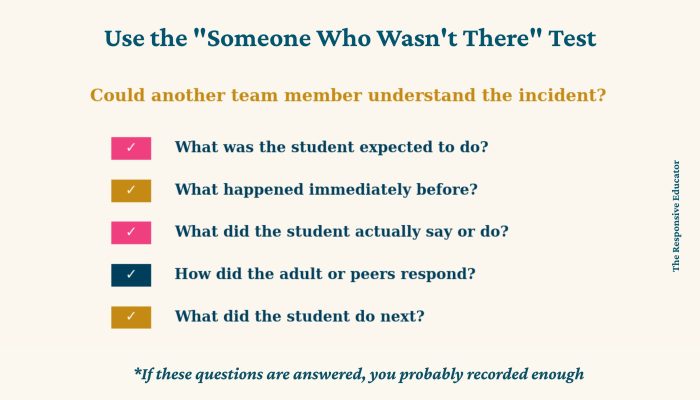
When I review an ABC incident report, I use one simple test:
If I had not been in the room, would I understand what happened?
If the report says only that the student was disruptive, the teacher redirected them, and the student went to the office, I would have several more questions. What was the student expected to be doing? What happened immediately before the behavior? What did the student actually do? How did the adult respond? What happened next?
That does not mean teachers should write a long narrative every time a student struggles. No one has time to stop instruction and document every detail of an incident. The goal is to capture the information that may matter later while the event is still fresh.
These Antecedent Behavior Consequence Chart examples will show what useful ABC data looks like, how objective documentation differs from interpretation, and what details help a team understand a behavior incident without creating unnecessary paperwork.
If you need an overview of the form before looking at completed examples, start with What Is an ABC Behavior Chart? It explains what each section records and when this type of documentation is useful.
A useful ABC entry does not have to be long. It needs to describe the sequence clearly enough that another person can understand what occurred.
The entry should answer three basic questions:
Depending on the behavior and the form being used, you may also need to record the activity, location, instructional format, duration, latency, or how the student responded after the consequence. The strongest entries are objective, specific, and brief. They describe what someone could see or hear without assuming what the student intended.
Even a well-designed form will produce inconsistent information if staff members do not agree on what behavior they are recording.
Broad labels may seem efficient, but they often mean different things to different people. One teacher may define refusal as saying “no.” Another may record refusal whenever a student does not begin immediately. Someone else may use the same label when a student puts their head down, pushes materials away, or leaves the room. Before collecting data, describe the behavior in observable terms.

A more useful definition might be:
The student verbally says “no,” “I’m not doing this,” or another statement refusing an adult direction; pushes assigned materials away; or does not begin the directed task within two minutes after confirming that the direction was understood.
A more useful definition might be:
The student hits, kicks, bites, scratches, pushes, or uses an object to make forceful contact with another person.
A more useful definition might be:
The student moves through the classroom doorway or more than ten feet away from the assigned group without adult permission.
A more useful definition might be:
The student yells above a conversational volume, knocks materials from a desk, throws classroom objects, or makes repeated noises that interrupt instruction.
The exact definition will depend on the student, setting, and concern. The important part is that two adults using the definition would be likely to record the same event.
Work refusal is a good example of how vague documentation can make an incident difficult to understand.
Context: Classroom
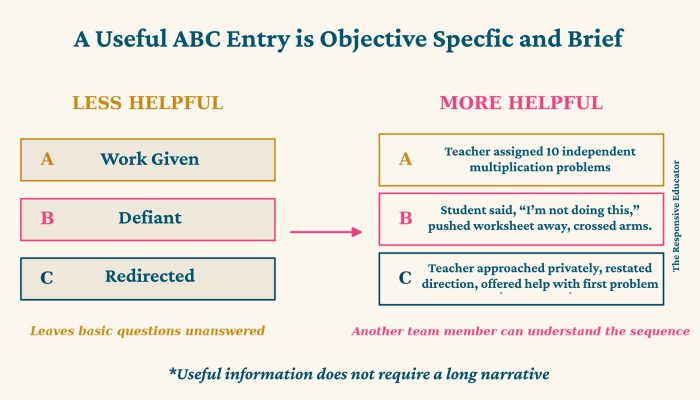
Antecedent: Work given
Behavior: Defiant
Consequence: Redirected
This entry is not necessarily inaccurate, but it leaves out most of the information the team would need. We do not know what assignment was presented, what the student did, how the teacher redirected the student, or how the student responded.
Context: Independent math practice
Antecedent: The teacher directed students to complete ten independent multiplication problems after two examples were completed together.
Behavior: The student said, “I’m not doing this,” pushed the worksheet toward the edge of the desk, crossed their arms, and did not begin working.
Consequence: The teacher approached privately, restated the direction, and offered to complete the first problem with the student.
Student response: The student completed the first problem with the teacher and then began working independently approximately one minute later.
The second entry replaces the label defiant with observable actions. It also records the specific task, what the teacher did immediately afterward, and how the student responded.
The observer is not claiming to know why the student refused. The entry simply provides enough information for the team to compare this incident with future observations.
If similar incidents continue, the team can later examine whether they repeatedly occur during multiplication, independent work, longer assignments, or tasks that require the student to begin without support. That analysis belongs after several observations have been collected, not in the individual incident report.
Aggression should be documented clearly without using emotionally loaded language or minimizing the safety concern.
Antecedent: Another student bothered him.
Behavior: Became violent.
Consequence: Removed from recess.
This entry contains several interpretations. We do not know what the other student did, what “became violent” means, or what happened immediately after the behavior.
Context: Students were lining up at the end of recess.
Antecedent: Another student stepped in front of the student in line and said, “I was here first.”
Behavior: The student pushed the peer with both hands and struck the peer twice on the right shoulder with an open hand.
Consequence: The supervising adult stepped between the students, directed the peer to move to another location, and prompted the student to walk to a nearby bench.
Student response: The student stopped making physical contact, walked to the bench, and continued yelling for approximately two minutes.
“Another student bothered him” assumes how the student experienced the interaction. “Became violent” does not identify the behavior that occurred. The revised entry documents what the peer said, the student’s observable actions, the adult’s immediate response, and what the student did next.
Safety takes priority during aggression. The adult should respond according to school procedures and the student’s plan rather than delaying action to complete the form. The incident can be documented as soon as it is safe and practical to do so.
Elopement and ordinary out-of-seat behavior should not be used interchangeably. Elopement generally involves leaving an assigned or supervised area and may present a significant safety concern.
Antecedent: Transition
Behavior: Ran away
Consequence: Staff followed
This entry tells us the general sequence, but it does not identify the transition, the boundary the student crossed, or what happened after staff responded.
Context: Transition from computer time to independent writing
Antecedent: The teacher gave a two-minute warning, then directed students to close their computers and take out their writing folders.
Behavior: The student closed the computer, walked quickly through the classroom doorway, and continued approximately 30 feet down the hallway without permission.
Consequence: The paraprofessional followed at a safe distance, reminded the student that the class was beginning writing, and directed the student to return.
Student response: The student stopped near the water fountain, stood silently for approximately one minute, and then returned to the classroom with the paraprofessional.
The revised entry identifies the specific transition and describes exactly where the student went. It also separates the student’s behavior from the adult’s response and records what happened after the direction to return.
The report does not label the behavior as attention-seeking, task avoidance, or an attempt to escape writing. Those may become hypotheses if a pattern develops across several observations, but they should not be presented as facts on the incident report.
The word disruptive can refer to many different behaviors. A student might call out, make noises, throw materials, argue, move around the room, or involve peers in off-topic conversations. If staff members record all of these actions under one broad label, meaningful differences among the behaviors may be lost.
Antecedent: Reading group
Behavior: Disruptive and disrespectful
Consequence: Teacher talked to student
This entry does not identify what happened during the group, what the student did, or how the teacher responded.
Context: Small-group reading instruction
Antecedent: The teacher asked the student to read the next paragraph aloud after the previous student finished.
Behavior: The student said, “This is stupid,” pushed the reading book away, and swept three word cards from the table onto the floor.
Consequence: The teacher directed the other students to continue reading silently, moved beside the student, and quietly restated the expectation to keep materials on the table.
Student response: The student stopped moving the materials, remained seated, and did not begin reading during the next three minutes.
The entry records several behaviors that occurred during one incident without combining them into the label disruptive. This matters because different parts of an incident may eventually show different patterns.
The notes also show that the student stopped moving materials but did not begin reading. That distinction may be important later. A consequence can stop one behavior without resolving the difficulty that contributed to the incident.
Off-task behavior requires a clear definition because students do not need to look perfectly still or stare at the teacher to be engaged. A student may doodle while listening, stand while working, use a fidget, or look away briefly without losing track of the lesson.
Before collecting ABC data, define what on-task or off-task behavior looks like during the specific activity.
Antecedent: Teacher was teaching.
Behavior: Student was not paying attention.
Consequence: Teacher redirected.
“Not paying attention” describes a conclusion. It does not tell us what the student did.
Context: Whole-group science lesson
Antecedent: The teacher began explaining written directions for a three-step experiment while displaying them on the board.
Behavior: The student turned away from the board, opened a book, and read the book for approximately two minutes.
Consequence: The teacher walked to the student’s desk, pointed to the directions on the board, and quietly prompted the student to put the book away.
Student response: The student closed the book, looked at the board, and copied the three steps into the science notebook.
The revised entry does not assume that the student chose to ignore the teacher. It records the observable behavior and the response that followed.
An ABC chart may be useful when the team needs to understand the circumstances surrounding specific episodes of disengagement. If the main question is how consistently the student remains on task throughout a lesson, interval recording may be a better measurement method. The type of data should always match the question the team needs to answer.

ABC charts are often associated only with challenging behavior, but the same framework can document successful replacement behaviors. This can help a team understand the conditions under which a student uses an appropriate skill.
Context: Independent writing
Antecedent: The student read the writing prompt and remained seated without writing for approximately one minute.
Behavior: The student raised their hand and said, “I have an idea, but I don’t know how to start my first sentence.”
Consequence: The teacher asked the student to explain the idea aloud and provided a sentence starter.
Student response: The student used the sentence starter to write the first sentence and continued working independently for the next eight minutes.
If we collect information only when a student is unsuccessful, we may overlook the conditions that support success. Documenting an appropriate request for help shows the replacement skill the student used, the adult response, and what happened next.
This does not mean teachers need to complete an ABC report every time a student behaves appropriately. It shows that the framework itself is neutral. It can help us examine successful behavior as well as challenging behavior.
A useful ABC incident report separates what the observer saw and heard from what the observer believes the behavior means.
A notes section is useful when an important detail does not fit into the other categories. It should not become a place to rewrite the entire incident as a long narrative. You might use the notes section to record:
If you do not know whether a detail is relevant, record it objectively rather than claiming that it caused the behavior. When several observations are reviewed later, a detail that seemed minor may help explain a repeated pattern.
Teachers are often collecting ABC data while simultaneously teaching, supervising students, and responding to the behavior itself. Mistakes do not necessarily mean someone was careless. They often reflect how difficult it is to document an incident accurately while managing everything else happening in a classroom. Knowing which errors to watch for can make the process more manageable.
Classrooms do not stop after a behavior incident. It is easy to plan to document the event later and then discover that several hours have passed. Our memories are not as reliable as they feel. Details about the activity, exact direction, sequence of responses, or student reaction begin fading quickly.
When possible, capture the basic information immediately. If you cannot complete the entire form, record a few key words that will help you finish it accurately as soon as practical.
Words such as manipulative, lazy, attention-seeking, and out of control may reflect how the incident felt to the adult. They do not tell another team member what occurred. Describe what the student said and did. Possible explanations can be considered later.
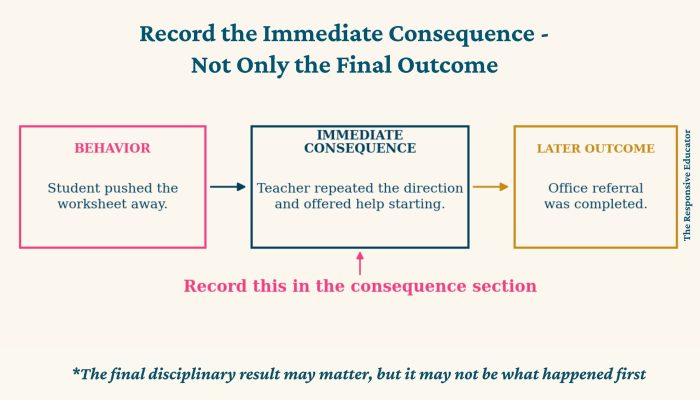
“Sent to the office” may be an important outcome, but it may not be the immediate consequence. Before the student went to the office, did the teacher repeat the direction? Did peers react? Was the assignment removed? Did an adult begin a conversation? Did the student gain access to a break?
The immediate response often provides information that the final outcome does not.
Writing “math class” may not be enough. Was the student participating in direct instruction, working independently, completing a test, working with a partner, or transitioning between activities? The type of activity and instruction may matter more than the physical location.
A single incident may involve verbal refusal, property destruction, aggression, and elopement. Recording the entire sequence as “defiance” makes it difficult to see which behaviors occurred. Identify the observable behaviors separately, even when they happened during the same incident.
Sometimes the antecedent is not clear. The behavior may appear to come “out of nowhere,” especially when the teacher is helping other students or managing several things at once.
Do not fill the gap with an assumption. Record that the immediate antecedent was not observed and continue collecting information. Another observer or additional observations may eventually provide the missing context.
Traditional ABC forms often provide three blank boxes and expect teachers to write a narrative. That format can work, but it depends on each observer remembering which details may become important later.
As I completed more Functional Behavior Assessments, I found myself asking the same follow-up questions. What activity was occurring? What type of instruction was being used? How long did the behavior last? How did the student respond after the adult intervened? Were several different behaviors included in the incident?
That is why I developed a checklist-style system. I wanted teachers and other staff members to be able to record important details through checkmarks and brief notes instead of reconstructing a lengthy incident at the end of the day.
If you want a form that prompts staff members to capture these details efficiently, my ABC Data Sheet Editable and Digital Graphing System includes printable and clickable incident reports. The forms provide space to document the setting, activity, instruction type, antecedent, behavior, consequence, duration, latency, and student response without requiring a long written narrative for every event.
The digital spreadsheet and graphing features will become especially useful after several reports have been completed. We will look more closely at that process in the next article.
There is no required number of sentences for a useful ABC entry. Some incidents can be documented through a few checklist selections and one short note. Other events require more explanation because several behaviors occurred or an unusual circumstance affected the incident.
Use the “someone who was not there” test:
Could another team member read this report and understand what happened without needing to ask several basic questions?
If the answer is yes, you probably recorded enough. If the reader still would not know what the student was expected to do, what behavior occurred, or how the adults responded, add the missing information. The goal is not perfect writing. It is useful information.
A single ABC behavior chart documents one incident. It may raise useful questions, but it should not be used by itself to determine the function of a behavior or make a major support decision.
Once several reports have been completed, the team can review them together to identify information that appears repeatedly. In How to Use an Antecedent Behavior Consequence Chart to Identify Behavior Patterns, I explain how to compare those observations, recognize possible patterns, and decide what additional information the team may need.
A useful Antecedent Behavior Consequence Chart does not require a long account of everything that happened. It should describe the relevant context, what occurred immediately before the behavior, what the student actually did, what happened next, and how the student responded when that information matters.
The goal is not to write a perfect report or complete another form for the sake of documentation. It is to preserve objective information while the incident is still fresh so the team can understand what occurred without relying on assumptions or memory. When those observations are later considered together, they can help educators ask better questions and make more thoughtful decisions about the skills, instruction, and support a student may need.


Support your students’ individual needs with our exclusive Classroom Concerns Checklist.
Identify key concerns in areas like cognitive skills, communication, social/emotional behavior, and more.
Sign up now to receive instant access and valuable insights on addressing classroom concerns.
Don’t miss out, join our community today!

Support your students’ individual needs with our exclusive Classroom Concerns Checklist.
Identify key concerns in areas like:
…and more to help drive collaboration and problem-solving.
Sign up now to receive instant access and valuable insights on addressing classroom concerns.