In the previous article, we talked about one of the biggest mistakes educators can make when supporting students with challenging behavior: trying to solve the wrong problem. Before we choose interventions, request a Functional Behavior Assessment (FBA), or develop a Behavior Intervention Plan (BIP), we first need to understand what is actually happening.
The next step is establishing a meaningful behavioral baseline.
Behavioral baseline data gives us an objective picture of where the student is starting before we introduce a new intervention. Without that starting point, it’s difficult to know whether the strategies we’re using are actually helping. More importantly, collecting good baseline data often helps us better understand the problem itself, leading to better decisions for students.
Years ago, I was asked to observe a first-grade student who had been repeatedly referred for refusing to complete his work. At first glance, it looked like a behavior problem. However, after gathering additional information, it became clear that the student wasn’t refusing because he was defiant. He was struggling because he lacked important foundational academic skills. Once the team understood the real problem, the intervention changed—and so did the student’s success.
That experience reinforced something I’ve seen throughout my career: good behavior data changes conversations.
Over the years, I’ve seen students referred for behavior programs when the primary concern was actually an academic skill deficit. I’ve also seen teachers spend valuable time collecting behavior data that never answered the questions the team was trying to answer. On the other hand, I’ve watched objective, well-collected baseline data help teams identify patterns, advocate for students, determine appropriate supports, and monitor meaningful progress over time.
The purpose of collecting behavioral baseline data is really twofold. First, it helps us understand what is happening so we can make better instructional and behavioral decisions. Second, it provides the objective documentation we often need to communicate with families, collaborate with school teams, advocate for services, and demonstrate whether interventions are making a difference. Good baseline data accomplishes both.
Unfortunately, many teachers are simply told to “collect behavior data” without anyone explaining what to collect, how to collect it, or why one type of data may be more useful than another. As a result, they spend valuable time documenting behaviors only to discover later that the information doesn’t answer the questions the team is trying to answer.
If you’ve ever been asked to “start collecting behavior data” and weren’t quite sure where to begin, you’re not alone. Even with a master’s degree in special education focused on emotional and behavioral disorders, many of the practical aspects of behavior data collection were things I refined through experience, research, and years of supporting teachers in real classrooms. My hope is that this article makes that process clearer, whether you’re a general education teacher, special education teacher, behavior specialist, or another member of a student support team.
In this article, I’ll walk you through how to establish meaningful behavioral baseline data, choose information that actually answers your questions, and build a strong foundation for the interventions, progress monitoring, Functional Behavior Assessments, and Behavior Intervention Plans that follow.

Behavioral baseline data is information collected before you begin a new intervention. It establishes a clear picture of what a student’s behavior looks like now so you have something meaningful to compare future progress against. Think of it as your starting point. If you don’t know where a student is beginning, it’s impossible to know whether the supports you’re providing are actually making a difference.
A good behavioral baseline helps answer questions like:
The answers to those questions become the foundation for everything that follows. They help you choose appropriate interventions, determine whether additional support is needed, and evaluate whether your efforts are working. Just as importantly, they give your team a common understanding of the problem based on observable facts rather than opinions.
Many people think of behavior data as paperwork, and I understand why. Documentation can feel like one more thing on an already full plate when you’re already trying to teach, manage behaviors, communicate with families, and keep up with everything else. However, when behavior data is collected thoughtfully, it becomes much more than paperwork. It becomes evidence that helps us understand what is happening and make better decisions for students.
Sometimes the evidence confirms what you already suspected. Other times, it completely changes your understanding of the situation. That’s exactly what happened with the first grader I described earlier. What initially appeared to be defiance turned out to be missing foundational academic skills. Without taking the time to gather better information, we easily could have chosen the wrong intervention.
Behavioral baseline data also plays an important role throughout a student’s educational journey. It helps teams identify behaviors that truly need intervention, determine whether classroom supports are working, decide when additional interventions or evaluations may be needed, and demonstrate student progress over time. It can also provide the documentation needed to qualify a student for services, support decisions about Functional Behavior Assessments (FBAs) and Behavior Intervention Plans (BIPs), or show that a student is ready for fewer supports or a less restrictive placement.
As teachers, administrators, school psychologists, behavior specialists, and families work together, those decisions should be based on evidence—not on who has the strongest opinion. Quantitative data helps take the emotion out of behavior management and shifts the conversation from opinions and assumptions to observable patterns and facts. That doesn’t mean we stop caring about students. It means we make decisions based on what we can clearly document while continuing to keep the student’s best interests at the center of every conversation.

One of the biggest misconceptions I see is that teachers think they have to create a brand-new data sheet every time they’re asked to collect behavior data. Sometimes that’s true, but often it isn’t. Before creating another behavior tracking sheet or behavior data collection form, take a few minutes to review the information you already have. Depending on the behavior you’re trying to understand, you may already have enough information to establish a meaningful behavioral baseline. If not, reviewing your existing documentation will help you determine what additional information you still need to collect.
Some of the first places I look include:
The type of behavior you’re investigating often determines whether your existing documentation is enough. For example, if you’re concerned about physical aggression, every incident may already be documented through office discipline referrals or other behavior reports. Looking back at those records may tell you how often the behavior has occurred, whether it has been increasing over time, and whether similar concerns existed during previous school years. In some situations, that may provide enough information to establish your behavioral baseline without starting from scratch.
Now compare that to a student who frequently calls out during instruction. The teacher may feel like the behavior is happening constantly, but unless someone has been specifically tracking each occurrence, there probably isn’t enough information to know whether it happens five times a day, twenty times a day, or only during one particular subject. Those situations require very different interventions, so you’ll likely need to begin collecting more targeted behavior data before implementing a new support plan.
The goal isn’t to collect as much data as possible. The goal is to collect enough of the right information to answer the question you’re trying to answer.

Something important to remember is that collecting more data isn’t always the answer. Sometimes we simply need different data.
I once worked with a teacher who was concerned about a student’s reading comprehension. She had done exactly what she had been asked to do and had been collecting reading data for several weeks. The problem wasn’t that she had failed to collect data. The problem was that she had been measuring reading fluency. Her data clearly showed how quickly the student could read, but it didn’t tell us whether the student understood what they were reading. She had collected good data—it just answered the wrong question.
The same thing happens with behavior. If you’re concerned about verbal disruptions but you’re only looking at office discipline referrals, you’re probably missing most of the picture because those behaviors rarely result in a referral. On the other hand, if you’re trying to determine how often a student becomes physically aggressive, office discipline referrals may provide an excellent starting point because those incidents are much more likely to be documented consistently.
Good behavioral baseline data isn’t about collecting the most data possible. It’s about collecting the right data for the behavior you’re trying to understand. Before you decide how you’re going to measure a behavior, make sure you’ve clearly identified the question you’re trying to answer.
This is one of the biggest mindset shifts I hope teachers take away from this article.
I’ve occasionally worked with teachers who had already decided what they thought a student needed before they ever started collecting data. For example, a teacher might ask, “How much data do I need before we can move this student to a behavior program?” I understand where that question comes from. Challenging behaviors can be exhausting, and teachers genuinely want help. However, I think there’s a better question to ask.
Instead of asking, “How much data do I need?” ask yourself, “What is this data helping us understand?”
That subtle shift changes the purpose of data collection from proving a point to solving a problem. Sometimes the data confirms what you suspected. Other times, it leads you in a completely different direction.
Think back to the first grader I described at the beginning of this article. The classroom teacher wasn’t wrong to ask for help. She recognized that something wasn’t working, and the documentation she had collected helped us begin asking better questions. As we gathered additional information, though, it became clear that the real issue wasn’t defiance at all. It was a significant gap in foundational academic skills. Once we understood the problem more clearly, the solution changed.
Approaching behavior data collection with an open mind helps us avoid making assumptions about students. Rather than collecting evidence to support a conclusion we’ve already reached, we use the data to guide our decision-making. That mindset almost always leads to better interventions and better outcomes for students.
Once you’ve reviewed the information you already have, it’s time to decide exactly what you’re going to measure.
One of the most common mistakes I see is trying to collect data on every concerning behavior at once. Students with challenging behavior often display several different behaviors throughout the day. They may call out, leave their seat, refuse work, argue with adults, and become physically aggressive under different circumstances. While all of those behaviors may be important, trying to measure all of them at the same time usually results in inconsistent data and frustrated teachers.
Instead, I recommend selecting one or two target behaviors, and no more than three. As you decide which behaviors to prioritize, consider which behaviors present the greatest safety concerns, cause the greatest disruption to learning, occur most frequently, or have the greatest impact on the student’s success throughout the school day. Focusing your efforts allows you to collect higher-quality data and gives your team a much clearer picture of whether your interventions are making a difference.
Keeping the number of target behaviors manageable isn’t just about making behavior documentation easier for teachers. It’s also about the student. Imagine being told there are six different things you’re doing wrong and being expected to improve all of them at once. Most students would feel overwhelmed before they even started. Focusing on one or two target behaviors gives students a realistic opportunity to experience success, build confidence, and see that their efforts are making a difference.
Once you’ve identified your target behavior, the next step is making sure everyone measures it the same way. That’s where operationally defining the behavior becomes essential.

Once you’ve selected your target behavior, the next step is making sure everyone involved understands exactly what that behavior looks like. This is where operationally defining the behavior becomes incredibly important.
An operational definition describes a behavior in clear, objective, and observable terms so that anyone reading it would know exactly what to look for. If five different adults observe the same student throughout the day, they should all be documenting the same behavior in the same way. Without a clear definition, everyone’s data may mean something different.
One of the most common mistakes I see is teachers documenting conclusions instead of behaviors. Teachers naturally want to summarize what happened, but those summaries often leave too much room for interpretation. Instead of describing what you think the behavior means, describe exactly what you saw and heard.
For example, imagine reading statements like these:
Those descriptions may be accurate, but they aren’t observable behaviors. They’re interpretations. Different people may have very different ideas about what “disrespectful” or “noncompliant” looks like. Instead, describe the specific actions you observed.
Here are a few examples of what that shift looks like in practice:
| Instead of writing… | Describe what you observed… |
|---|---|
| The student was disrespectful. | The student rolled his eyes, said, “I’m not doing that,” pushed his math book onto the floor, and walked away from his desk. |
| The student was physically aggressive. | The student hit another student on the arm with an open hand during recess. |
| The student refused to work. | The student completed 2 of 20 math problems after three teacher prompts during independent work. |
| The student had a meltdown. | The student cried, yelled, dropped to the floor, and kicked the wall for approximately six minutes. |
Notice the difference? Anyone reading the examples in the second column knows exactly what happened. There is very little room for interpretation because the behaviors are observable and measurable. When I review behavior documentation, I often ask teachers to imagine someone reading their notes six months from now. Would they know exactly what happened, or would they have to guess what you meant? If someone has to guess, the behavior probably isn’t operationally defined clearly enough.
That level of detail is important for several reasons. First, it allows everyone on the team to collect behavior data consistently. Second, it makes it much easier to identify patterns over time because everyone is documenting the same behavior instead of their own interpretation of it. Finally, objective documentation keeps conversations focused on facts rather than opinions.
I’ve found that when teachers begin writing exactly what they see instead of what they think it means, their behavior data becomes much more useful. Not only does it help the team make better decisions, but it also helps teachers notice patterns they may have missed before. When we stop labeling behaviors and start describing them, we begin asking better questions. That’s where real problem-solving starts.
That shift also changes conversations with families and other members of the educational team. Labels like defiant, disrespectful, or noncompliant invite disagreement because different people interpret those words differently. Observable behavior is much harder to argue with. Instead of debating whether a student was “being disrespectful,” the team can focus on what the student actually said or did, what may have contributed to the behavior, and what support will help the student be more successful in the future.
This doesn’t mean we ignore the student’s feelings or the reasons behind the behavior. In fact, understanding why a behavior is occurring is one of the most important parts of supporting students effectively. However, before we can begin asking why a behavior is happening, we first need to make sure we’re all talking about the same behavior. A clear operational definition gives the entire team that shared understanding.

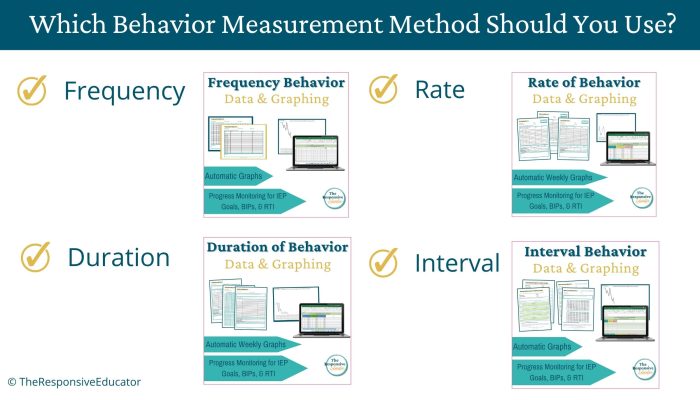
Once you’ve clearly defined your target behavior, the next question becomes: How should I measure it? There isn’t one behavior data collection method that works for every situation because different methods answer different questions. The best measurement system depends on the specific behavior you’re trying to understand and the information you need to make good decisions.
For example, if you’re trying to reduce the number of times a student calls out during instruction, you’ll probably want to measure frequency because you’re interested in how often the behavior occurs. If a student has lengthy tantrums or emotional outbursts, duration may provide much more useful information because the length of the behavior is just as important as whether it occurred. Other behaviors are better measured using interval recording, while some situations call for rate, latency, or another behavior measurement method altogether.
Using the wrong measurement system can leave you with data that doesn’t actually answer the question you’re trying to answer, even if you’ve been documenting consistently. Choosing the right method from the beginning makes it much easier to identify meaningful patterns and determine whether your interventions are actually working.
We’ll take a much deeper look at each of these behavior measurement methods in separate articles. If you’re unsure which method best fits your target behavior, I recommend starting with my article on Choosing the Right Behavior Measurement Method. From there, you can explore frequency, duration, interval, rate, and the other measurement systems in more detail as you determine which one best fits your situation.
If you’re looking for editable behavior tracking sheets, automatic Excel graphing tools, and multiple behavior data collection forms, I’ve also created a Behavior Progress Monitoring Tracking Sheet + Graphing Bundle. It includes several different measurement methods, so you can choose the one that best fits the behavior you’re measuring instead of trying to force every behavior into the same data sheet. Whether you create your own forms or use mine, the important thing is selecting a measurement system that answers the question you’re trying to answer.
One of the questions I’m asked most often is, “How much baseline data do I need before I can begin an intervention?” The honest answer is, it depends.
Rather than aiming for a specific number of days, your goal should be to collect enough data to establish a stable, representative picture of the behavior before making decisions. Some behaviors occur many times throughout the day, allowing you to identify patterns fairly quickly. Others happen only occasionally, which means you’ll need a longer period of observation before you can confidently say you understand what’s happening.
In many classroom situations, three to five days of quality data may be enough to identify a consistent pattern, especially if the behavior occurs frequently. Other behaviors may require a week or more of data collection before you have a reliable baseline. The important thing isn’t reaching an arbitrary number of days—it’s making sure the data accurately represents the student’s typical behavior.
Existing documentation should also be part of that picture. Office discipline referrals, previous behavior documentation, attendance records, parent input, and information from previous school years can all help establish a more complete understanding of the student’s behavior. While historical information isn’t your behavioral baseline by itself, it provides valuable context that can help your team make better decisions.
Once you’ve established a meaningful baseline, you’re ready to begin implementing interventions. As you continue collecting the same type of behavior data after the intervention begins, you’ll be able to compare those results to your baseline and determine whether the intervention is actually helping.
Behavior data by itself doesn’t change behavior. The purpose of collecting a baseline isn’t simply to complete paperwork or fill in data sheets. It’s to make better instructional decisions. A well-established baseline helps you choose interventions that match the student’s needs instead of relying on assumptions or trial and error.
Just as importantly, collecting the same type of data after an intervention begins allows you to answer one of the most important questions in behavior support: Is what we’re doing actually helping? If the data shows improvement, you’ll have evidence that the intervention is working. If the behavior isn’t changing, the data gives your team the information needed to adjust the plan rather than continuing with an approach that isn’t producing results.
Throughout this framework, you’ll notice that behavior data isn’t the end goal. The goal is helping students learn the skills they need to be successful. Data simply helps us understand where they’re starting, identify what they need, and measure whether the support we’re providing is making a meaningful difference.

One thing I’ve always tried to do, whether I was supporting teachers in general education classrooms or working as the behavior specialist at an alternative school, was make behavior documentation as efficient as possible.
Teachers are busy. Paraprofessionals are busy. No one has time to complete multiple complicated data sheets for one student every day, especially if the information isn’t helping anyone make better decisions.
While working as a behavior specialist, I noticed our staff was documenting far more than they needed to, but we still weren’t collecting the information that actually helped us monitor student progress. One incident report might include defiance, verbal aggression, physical aggression, and elopement, all recorded as a single event. That made it almost impossible to tell whether one behavior was improving while another was becoming more frequent.
After securing classroom iPads for our paraprofessionals, we simplified the documentation process so staff could record each target behavior as it occurred throughout the day. Teachers and paraprofessionals actually spent less time collecting data, but the quality of our information improved dramatically because each behavior was being measured consistently and individually. Instead of collecting more paperwork, we were collecting better information.
That experience reinforced something I still believe today: the best behavior data collection system is one that teachers and support staff can realistically use every day. A complicated system that isn’t completed consistently won’t help anyone, no matter how well it’s designed.
If you’re creating your own behavior tracking forms, keep them as simple as possible while still collecting the information you need. If you’d rather start with a system that’s already organized, my Behavior Progress Monitoring Tracking Sheet + Graphing Bundle includes editable data collection forms, multiple behavior measurement methods, and automatic Excel graphs designed to make progress monitoring more efficient.
I created these tools to solve the same challenges I encountered in the classroom—helping teachers and paraprofessionals collect meaningful data without creating unnecessary work. Whether you use my resources or develop your own, the goal is the same: create a system that’s practical enough to use consistently and useful enough to guide your decisions.

Even experienced educators occasionally make mistakes when collecting behavior data. Fortunately, most of them are easy to avoid once you know what to look for. Here are the ones I see most often.
When a student is struggling, it’s tempting to document everything. Unfortunately, trying to collect data on every behavior usually results in inconsistent documentation and an overwhelmed teacher. Focus on one or two target behaviors, and no more than three, so both you and the student have a realistic opportunity to be successful.
Good behavior data answers a specific question. Before creating a data sheet, ask yourself, “What am I trying to learn?” If you’re concerned about verbal disruptions but only tracking office discipline referrals, you’re probably measuring the wrong thing. The goal isn’t simply to collect data—it’s to collect information that helps you make better decisions.
When documenting behavior, describe exactly what the student said or did rather than what you believe the behavior meant. Objective, observable descriptions allow everyone on the team to collect data consistently and make discussions with families and colleagues much more productive.
Behavior data is only useful if it reflects what is actually happening. Skipping days, changing measurement methods halfway through, or having different adults collect data in different ways makes it much harder to identify meaningful patterns over time. Consistency is often more valuable than collecting large amounts of data.
This may be the biggest mistake of all. Behavior data should never become paperwork that sits in a file until the next meeting. Review it regularly, look for patterns, ask questions, and let the information guide your next steps. The purpose of collecting behavioral baseline data isn’t to fill out forms—it’s to make better decisions that help students succeed.
Collecting behavioral baseline data can feel overwhelming when you’re first learning the process, especially if no one has ever shown you how all the pieces fit together. The good news is that, like most things in education, it becomes much easier with practice.
Remember that a good behavioral baseline is simply your starting point. It helps you understand what is happening before you decide what to do next, gives your team a common understanding of the concern, and provides a meaningful way to measure whether your interventions are actually helping.
Throughout this Behavior Support Framework, you’ll notice that the goal is never to collect data for its own sake. The goal is to understand students well enough to make thoughtful instructional decisions, teach the skills they’re missing, and evaluate whether the support you’re providing is making a meaningful difference. Good data doesn’t replace professional judgment—it strengthens it.
In the next article, we’ll look more closely at Choosing the Right Behavior Measurement Method so you can select a data collection system that answers the specific questions you’re trying to answer.


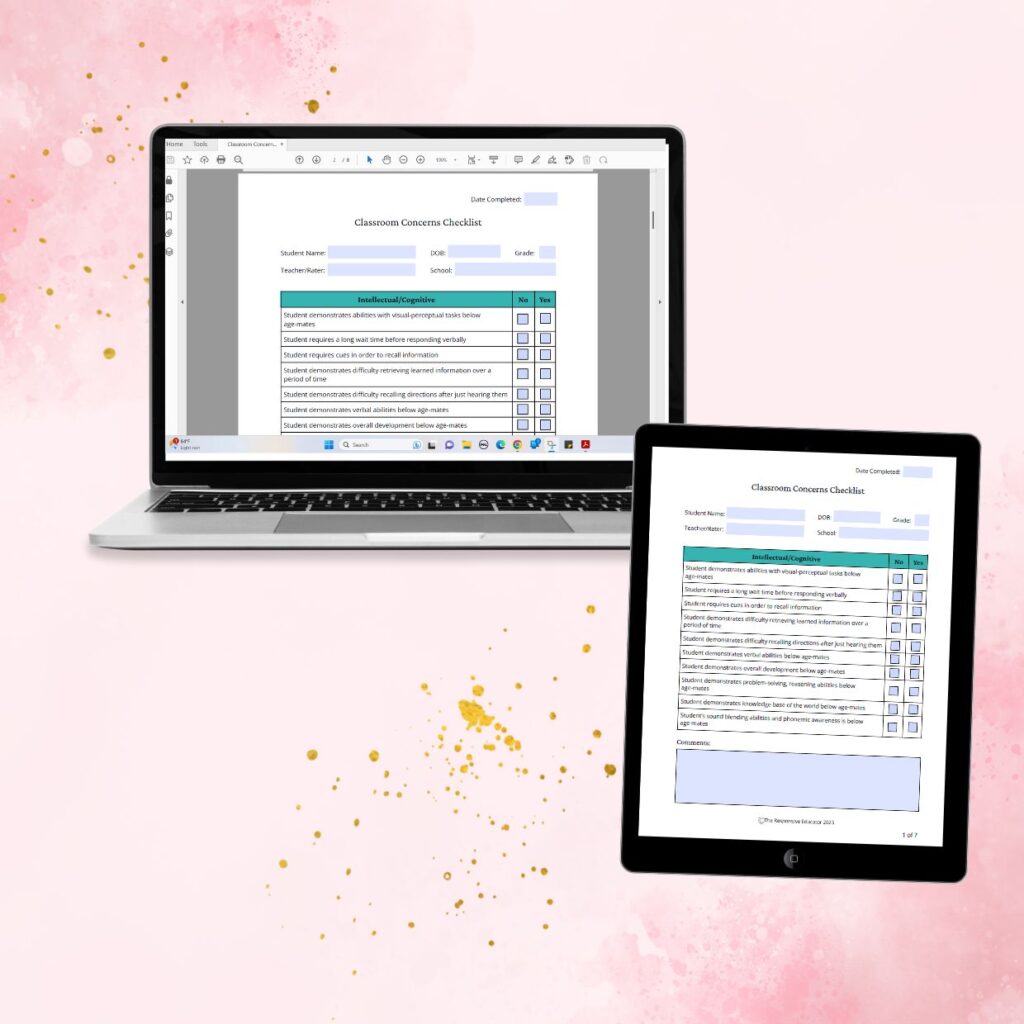
Support your students’ individual needs with our exclusive Classroom Concerns Checklist.
Identify key concerns in areas like cognitive skills, communication, social/emotional behavior, and more.
Sign up now to receive instant access and valuable insights on addressing classroom concerns.
Don’t miss out, join our community today!

Support your students’ individual needs with our exclusive Classroom Concerns Checklist.
Identify key concerns in areas like:
…and more to help drive collaboration and problem-solving.
Sign up now to receive instant access and valuable insights on addressing classroom concerns.