Every teacher has worked with a student who seems to need the same directions over and over again.
You explain the routine. The student appears to be listening. They nod their head, say they understand, and even begin the first step. A few minutes later, however, they’re doing something completely different. The assignment hasn’t been started. The materials they need aren’t on their desk. When you ask what happened, they often seem just as confused as you are.
After a while, it’s easy to become frustrated. Adults may begin to assume the student isn’t listening, isn’t paying attention, doesn’t care, or simply isn’t trying very hard.
In many cases, though, that isn’t what’s happening at all.
Some students genuinely intend to follow directions. They want to complete their work. They want to stay organized. They know what they’re supposed to do. The problem is that knowing what to do and successfully managing all of the steps required to do it are not always the same thing.
This is where executive functioning skills come in.
Executive functioning skills help students manage themselves, their attention, their materials, their behavior, and their emotions. These skills affect nearly everything students do throughout the school day. When executive functioning skills are underdeveloped, students often struggle with tasks that appear simple to others. As a result, they are frequently viewed as lazy, careless, irresponsible, or unmotivated when the real issue may be that they are missing skills they need to be successful.
One of the reasons executive function problems are so often misunderstood is that adults don’t actually see the skill deficit itself. What we see are the outcomes. We see forgotten assignments, incomplete projects, messy desks, impulsive comments, missing materials, and students who seem unable to follow through. Without understanding executive functioning, it’s easy to assume these behaviors are intentional when they may actually be signs that a student needs support.

One of the most common executive function examples involves following directions. A teacher gives a student several instructions. Put away your reading book. Take out your math notebook. Complete the first three problems. Meet with a small group when you’re finished.
The student understands every step. Unfortunately, understanding the directions and successfully carrying them out require more than simply hearing the words. The student must remember the steps, ignore distractions, keep track of where they are in the process, manage materials, and follow through until the task is complete.
For students with working memory difficulties, that process can fall apart quickly.
This is one reason so many students become frustrated. They often receive corrections for something they believed they were trying to do. Teachers may feel like students aren’t listening, while students feel like they are constantly getting in trouble for mistakes they never intended to make.
This is why simply repeating directions over and over is often ineffective. If the underlying issue is executive functioning, students usually need strategies rather than additional reminders. Visual supports, checklists, written directions, and consistent routines often help far more than repeating the same verbal instruction for the fifth time.

Another common executive functioning challenge involves organization.
Every school has students who never seem to have what they need. Their folders are missing. Their desk is overflowing. Their homework is crumpled in the bottom of a backpack. They spend valuable instructional time searching for materials while everyone else is ready to begin.
Adults often assume these students simply need to “be more responsible.” The problem is that organization is itself a skill. Students who struggle with executive functioning often have difficulty creating systems, maintaining systems, and using systems consistently over time. Telling a student to be organized is similar to telling a struggling reader to read better. The statement may identify the problem, but it doesn’t teach the skill.
What these students frequently need is explicit instruction. They may need to be taught how to organize materials, how to use folders effectively, how to check whether they have everything they need before leaving class, and how to create routines that reduce the likelihood of forgetting important items.

Executive function skills also affect planning and time management. Teachers often see this when long-term projects are assigned. While some students begin planning immediately, others genuinely believe they have plenty of time. Weeks pass. The project remains untouched. Suddenly the due date is approaching, and the student is overwhelmed.
Adults sometimes interpret this as procrastination. In reality, many students struggle to accurately estimate how long tasks will take. They assume they can complete everything later because they have difficulty visualizing the future demands of the project.
These students often benefit from structures that break larger assignments into smaller pieces. Checkpoints, timelines, planning sheets, and teacher conferences help make the invisible process of planning more concrete. Over time, these supports can help students develop stronger executive function planning skills and become more independent.

Not all executive function problems involve forgetting or losing things.
Some students move so quickly that they create problems for themselves. They rush through assignments, skip directions, miss punctuation, overlook spelling errors, and turn in work that doesn’t reflect what they actually know. I work with students who know how to use punctuation correctly and can accurately spell many of the words they miss in their writing. The issue isn’t a lack of knowledge. The issue is that they are focused on being finished rather than monitoring the quality of their work.
One strategy that has been particularly helpful is copywork. By carefully copying short passages and gradually increasing the length over time, students learn to slow down and pay attention to details they would normally overlook. While many students initially find this frustrating, it often helps build the stamina and attention to detail needed for more independent writing tasks.
This is another reminder that executive functioning interventions are often most effective when they directly teach the skill that is missing. Simply telling students to slow down rarely teaches them how.

Executive functioning challenges often appear in social situations as well. Many students struggle with inhibition and impulse control. They blurt out answers, interrupt conversations, make inappropriate comments, or say things that hurt peers without considering the consequences first.
When adults respond by asking, “What were you thinking?” the honest answer is sometimes that the student wasn’t thinking about the outcome at all. They reacted before they had an opportunity to consider how their words might affect someone else.
This doesn’t mean students shouldn’t be held accountable for their actions. It does mean that consequences alone are unlikely to solve the problem.
Students frequently need explicit instruction in pausing, reflecting, and considering potential outcomes before they respond. Just as we teach academic skills directly, many students need direct instruction in the executive functioning skills that support successful social interactions.

One of the biggest mistakes educators make is assuming that repeated mistakes automatically indicate a lack of effort.
Many students with executive function ADHD challenges or other executive functioning difficulties desperately want to be successful. They want to remember their homework. They want to stay organized. They want to complete assignments on time. What they often lack are the systems and strategies necessary to do those things consistently.
This is why executive functioning accommodations and executive functioning strategies can be so powerful. Checklists, visual schedules, assignment trackers, organizational systems, planning tools, and structured routines help reduce the demands placed on executive functioning while students continue developing those skills. The goal is not to create lifelong dependence on supports. The goal is to teach students how to use supports effectively and gradually build independence over time.

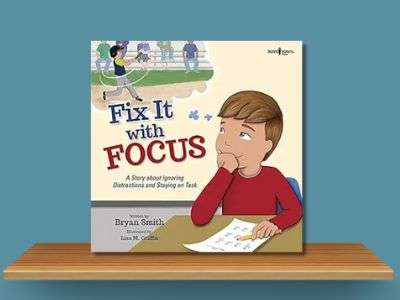
One of my favorite executive function books is Fix It With Focus by Bryan Smith. The story follows Blake, a student who struggles with distractions and staying on task. Like many students with executive functioning difficulties, Blake isn’t trying to make poor choices. He simply has difficulty managing his attention and following through on expectations consistently.
What makes this book particularly useful is that it moves beyond identifying the problem and focuses on solutions. Students see practical strategies that can help them improve focus and manage distractions more successfully.
For teachers looking to introduce conversations about executive functioning, attention, and self-regulation, this book provides a relatable starting point. It is also one of the books featured in my roundup of ADHD and focus picture books for children.
*If you purchase something from a link on my website, I receive a small commission at no cost to you.
One challenge with executive functioning is that it is a broad term. Two students may both struggle academically while having very different executive function needs. One student may have difficulty with planning and organization. Another may struggle with working memory. A third may have significant challenges with emotional regulation or impulse control.
When we treat executive functioning as a single skill, it becomes difficult to identify what students actually need.
This is one reason I created my Executive Functioning Skills Checklists.
The checklists function as both an executive function assessment and an executive function checklist that helps educators identify specific strengths and areas of need. Rather than relying on general observations such as “disorganized” or “struggles with focus,” teams can examine specific executive function areas and determine which skills require support.
Each checklist includes an executive function skills list organized by area, executive functioning interventions, executive functioning accommodations, sample executive functioning goals, and executive functioning IEP goals. Because executive function skills develop over time, separate versions are available for K-2, 3-5, 6-8, and 9-12 students, making it easier to evaluate executive function skills by age and identify developmentally appropriate supports.
Whether you’re creating an intervention plan, developing accommodations, writing goals, or simply trying to better understand a student’s needs, having a structured executive functioning checklist can make the process much more manageable.
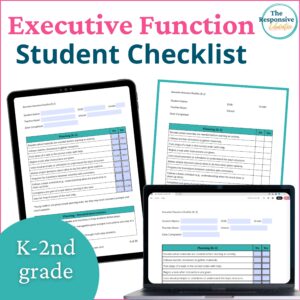
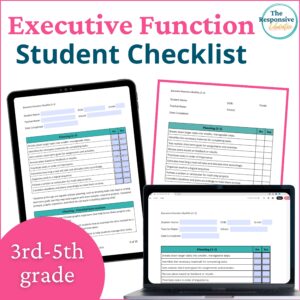
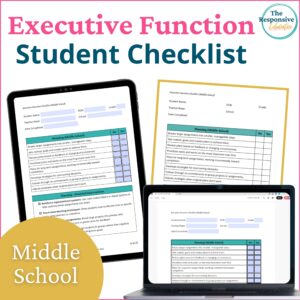
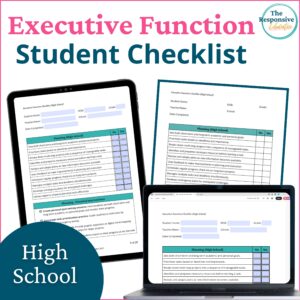
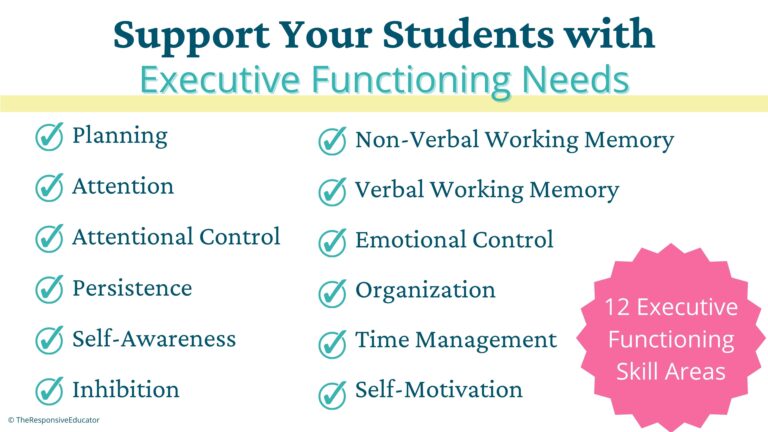
The checklist examines 12 executive function areas so educators can move beyond general observations such as “disorganized” or “struggles with focus” and identify the specific skills that need support.
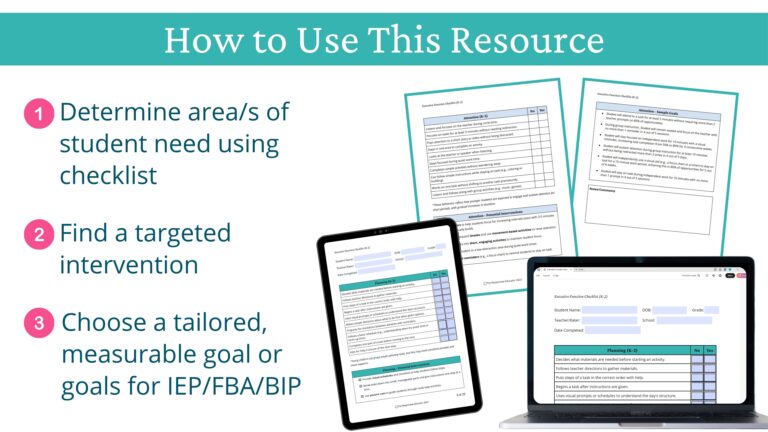
Instead of spending hours searching for interventions, accommodations, and goal ideas, educators can use the checklist to identify areas of need, select targeted supports, and develop measurable goals aligned to the student’s specific executive functioning challenges.
Executive functioning skills affect nearly every part of a student’s day. They influence how students follow directions, manage materials, complete assignments, interact with peers, regulate emotions, and solve problems.
When these skills are weak, the resulting behaviors are often misunderstood. Students may appear careless, lazy, unmotivated, or defiant when they are actually struggling with planning, organization, working memory, impulse control, or self-monitoring.
Understanding executive functioning helps us move beyond frustration and toward effective support. Instead of repeatedly asking why students aren’t doing what they are supposed to do, we can begin identifying the skills that need to be taught. When we teach strategies, provide appropriate supports, and focus on skill development rather than assumptions, we give students a much better chance of becoming successful, independent learners.
Stories can help students recognize executive functioning challenges in characters—and begin talking about the strategies that might help. These executive function books for kids provide useful starting points for conversations about planning, organization, attention, flexibility, and self-control.


Support your students’ individual needs with our exclusive Classroom Concerns Checklist. Identify patterns in areas like cognitive skills, communication, social/emotional behavior, and more.
Sign up now to receive instant access and valuable insights on addressing classroom concerns.

Support your students’ individual needs with our exclusive Classroom Concerns Checklist.
Identify key concerns in areas like:
…and more to help drive collaboration and problem-solving.
Sign up now to receive instant access and valuable insights on addressing classroom concerns.
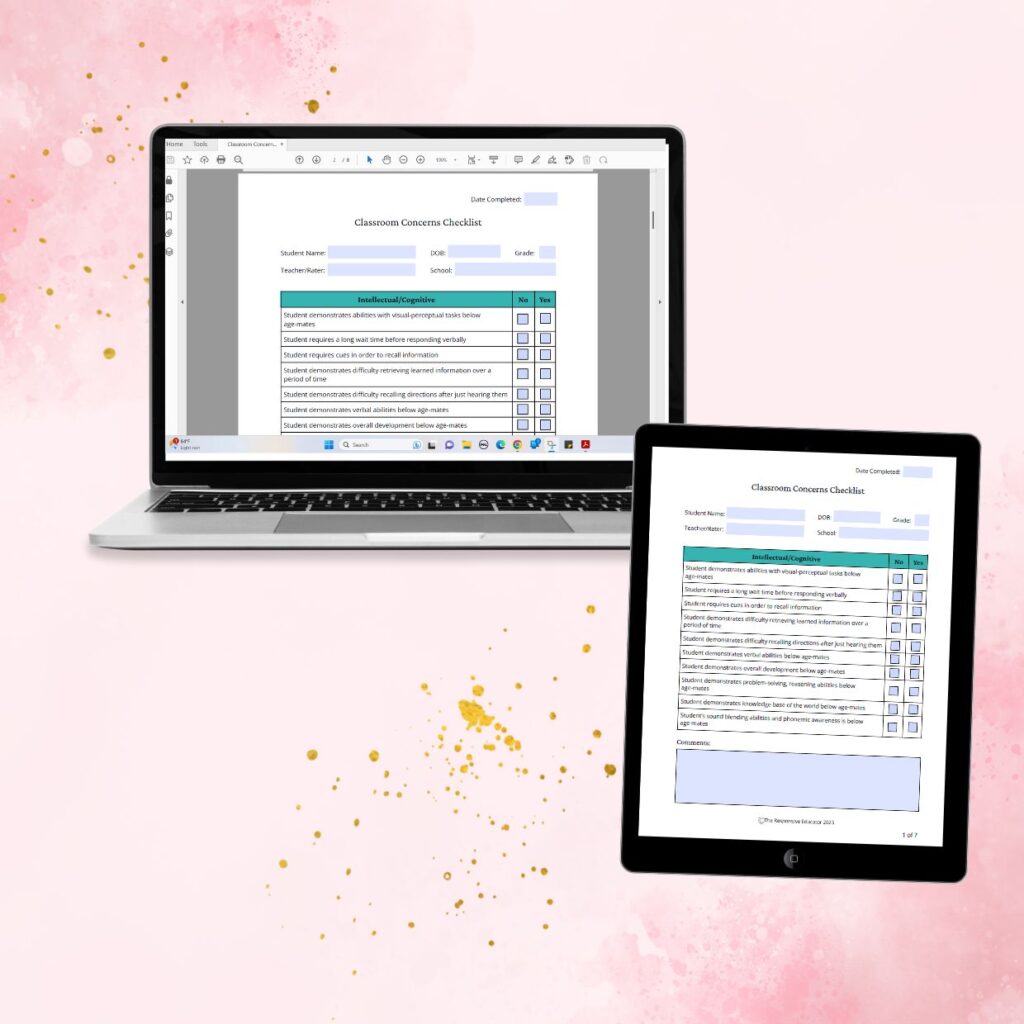
When a student is struggling, it can be difficult to know what information matters or what to look at next. The free Classroom Concerns Checklist can help you organize what you are seeing, identify patterns, and decide what information your team may need.