Imagine observing a student who calls out every few seconds during a lesson. You begin with a frequency count because you want to know exactly how many times the behavior occurs. After only a few minutes, however, you have already lost track. Was it 37 call-outs? Forty-three? More than fifty?
When a behavior occurs that frequently, trying to count every occurrence can quickly become frustrating and unreliable. Even if you manage to complete the observation, the exact number may not be the information you actually need.
Instead of asking, “How many times did the student call out?” a more useful question might be, “How consistently was this behavior occurring throughout the lesson?” Knowing that a student called out 52 times tells you something, but recognizing that the behavior occurred during nearly every portion of the lesson may give you a clearer picture of its effect on instruction.
That is where interval recording becomes valuable. Instead of counting every occurrence, you divide the observation into equal periods of time, called intervals. You then record whether the behavior occurred according to the type of interval recording you are using.
You give up some of the precision of frequency recording, but you gain something equally important: a practical way to collect meaningful data about a behavior that happens too often to count accurately. For many teachers, that trade-off makes interval recording one of the most useful behavior measurement methods available.
If you are still deciding whether interval recording is the appropriate measurement method, begin with Behavior Data Collection: How to Choose the Right Measurement Method. That article explains when frequency, duration, rate, interval, and other measurement methods are most likely to answer the question you are asking.

Every behavior measurement method answers a different question. Frequency tells you how many times a behavior occurred. Duration measures how long it lasted. Rate allows you to compare behavior across observation periods of different lengths. Interval recording helps you estimate how consistently a behavior occurred throughout an observation.
Interval recording is especially useful when a behavior occurs so frequently that counting every instance is not realistic. Instead of focusing on the exact number of occurrences, you are looking for a clearer picture of how much of the observation was affected by the behavior. That may provide the information you need while making data collection much more manageable during instruction.
You might choose interval recording when a student frequently calls out during lessons, engages in repetitive vocalizations, rocks or taps almost continuously, leaves an assigned area throughout independent work, or is learning to maintain an appropriate replacement behavior. In situations like these, knowing whether the behavior occurred during each interval may be more useful than trying to determine whether it happened 42 times or 57 times.
The goal is not to create the most complicated data collection system possible. The goal is to collect data that represents the student’s behavior accurately enough to guide your decisions while remaining realistic for the people expected to collect it. A slightly less precise system that is used consistently will usually provide more useful information than a highly detailed system that no one can maintain.
Although interval recording is sometimes discussed as one measurement method, partial interval recording and whole interval recording do not measure behavior in exactly the same way. Both divide an observation into equal periods, but the criteria for marking an interval are different.
The distinction comes down to the question you are trying to answer. Partial interval recording tells you whether a behavior occurred at any point during an interval. Whole interval recording tells you whether a behavior continued for the entire interval.
Partial interval recording is commonly used when a team is monitoring a behavior it wants to decrease. Whole interval recording is often used when a team wants to know whether a positive or replacement behavior is being maintained. Those are useful general guidelines, but the method should ultimately be selected according to what you need the data to represent—not simply whether you consider the behavior positive or challenging.
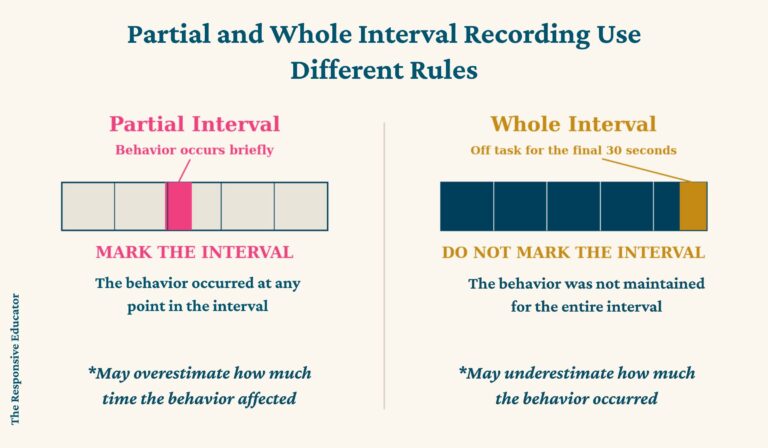
With partial interval recording, you mark the interval if the behavior occurs at any point during that interval. It does not matter whether the behavior happens once or continues throughout most of the interval.
Suppose you observe a student for 30 minutes using five-minute intervals. That gives you six intervals to score. If the student calls out once during the first five minutes, you mark that interval. If the student calls out 20 times during the next five minutes, you also mark that interval.
This is an important limitation to understand. Partial interval recording does not tell you exactly how many times the behavior occurred. It shows you the percentage of intervals in which the behavior was present.
I think of partial interval recording as answering the question, “During how much of this observation did the behavior show up at least once?” If calling out occurs during nearly every interval, that tells you the behavior is spread throughout the lesson, even though the data does not provide an exact count.
Partial interval recording tends to overestimate the amount of time affected by a behavior. A behavior that occurs for only a few seconds causes the entire interval to be marked. That does not make the data inaccurate, but it does affect what conclusions you can draw from it.
You may see partial interval recording ABA materials describe the method as a discontinuous measurement procedure. “Discontinuous” means you are not recording every occurrence or every second of the behavior. You are sampling whether the behavior occurred during defined periods.
The same principle applies in a classroom. A teacher may not be able to record every instance of a high-frequency behavior while also teaching, responding to students, and managing the lesson. A partial interval recording data sheet offers a structured way to sample the behavior without pretending that the resulting percentage is an exact count or an exact measure of duration.
Whole interval recording uses a stricter scoring rule. You mark the interval only when the student demonstrates the target behavior for the entire interval.
Suppose you are monitoring on-task behavior during independent work using five-minute intervals. The student must remain engaged for the full five minutes for that interval to be marked as successful. If the student becomes distracted during the final 30 seconds, the interval does not receive credit.
Whole interval recording is often helpful when you are teaching a student to maintain a replacement behavior, such as remaining engaged, working independently, or staying in an assigned area. It allows you to see whether the behavior is becoming more consistent and sustainable rather than simply appearing briefly.
However, whole interval recording tends to underestimate how much the behavior occurred. A student might remain engaged for four minutes and 45 seconds of a five-minute interval but receive no credit because the behavior was not maintained for the entire interval. Again, the data is not wrong. It is simply answering a specific question using a strict standard.
Resources about whole interval recording ABA may also describe it as discontinuous measurement because it produces an estimate rather than a continuous record of the behavior. In school settings, the method is often used to monitor behaviors that need to be sustained over time.
Whole interval recording can be useful, but the interval must be realistic for the student’s current skill level. Requiring a student who can currently remain engaged for only one or two minutes to meet a ten-minute whole-interval standard may hide meaningful progress. In that situation, shorter intervals would allow the data to show growth while the student works toward greater independence.
Neither method is automatically better than the other. Each one gives you a different kind of estimate.
Partial interval recording may overestimate how widely a behavior affected the observation because one brief occurrence causes the entire interval to be marked. Whole interval recording may underestimate a student’s successful behavior because anything less than the entire interval receives no credit.
Before selecting a method, ask what you need someone to understand when they review the data. If you want to know whether a challenging behavior appeared throughout the observation, partial interval recording may give you the clearer picture. If you want to know whether a student maintained a replacement behavior consistently, whole interval recording may be the better fit.
Once you have selected the type of interval recording, you need to determine the length of each interval. Shorter intervals generally provide more detailed information because you have more opportunities to record changes in behavior. However, they also demand more attention from the person collecting the data.
When I was observing a student while someone else taught, I could use one-minute intervals for a very high-frequency behavior. Because collecting data was my main responsibility during that observation, I could closely monitor when each interval ended and record the student’s behavior consistently.
If the classroom teacher needed to collect the data while teaching, I was more likely to recommend five-minute intervals. The data was not quite as detailed, but the system was much more realistic. A teacher could check the student’s behavior, mark the interval, and continue teaching without allowing the recording process to take over the lesson.
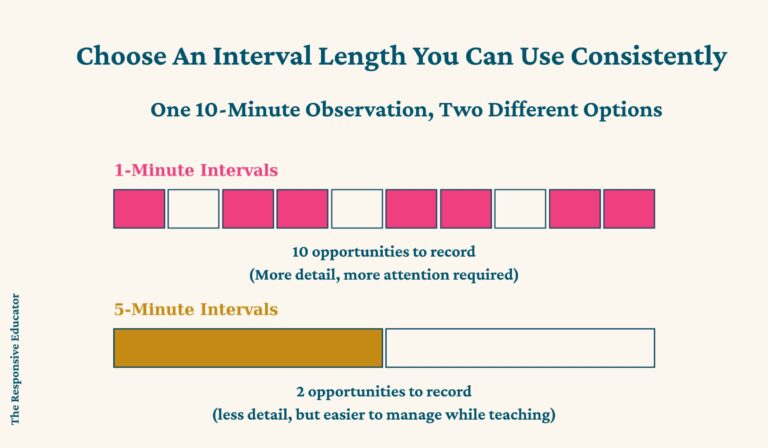
The most detailed data collection system is not always the most useful one. A partial interval recording data sheet with one-minute intervals will not help if the teacher regularly misses intervals because the system requires more attention than the classroom allows.
The interval length should match the behavior, the student’s present level of performance, and the realities of the environment. Sometimes that means collecting detailed interval data during a formal observation. At other times, it means choosing a simpler interval count that staff members can use consistently each day.
After the observation, divide the number of intervals marked by the total number of intervals observed. Then multiply the result by 100 to find the percentage.
For example, imagine that you observed a student across ten intervals and marked the behavior during seven of them:
7 marked intervals ÷ 10 total intervals = 0.70
0.70 × 100 = 70%
You would report that the behavior occurred during 70% of the observed intervals. With partial interval recording, that means the behavior occurred at least once during 70% of the intervals. With whole interval recording, it means the student maintained the behavior for the entire interval during 70% of the observation periods.
Those two percentages may look the same on an interval graph, but they do not mean the same thing. The data sheet, graph title, and progress notes should clearly identify whether you used partial interval recording or whole interval recording so that anyone reviewing the results can interpret them correctly.
Interval data is only useful when the recording system matches the behavior and remains consistent across observations. Most problems can be prevented by making a few decisions before data collection begins.
It is easy to choose partial interval recording when whole interval recording would answer the question better—or the reverse. Before collecting data, decide exactly what you need the measurement to represent.
If you are monitoring whether calling out, repetitive noises, or leaving an assigned area occurred at any point throughout the lesson, partial interval recording may be appropriate. If you are measuring whether a student remained engaged, worked independently, or stayed in an assigned area for sustained periods, whole interval recording may provide more meaningful information.
The distinction is not simply “challenging behavior versus positive behavior.” Your operational definition, scoring rule, and decision-making question all need to fit together.
Long intervals can hide important differences in behavior. If a student calls out once during every ten-minute interval, partial interval data may suggest that the behavior occurred across 100% of the observation. Someone looking only at that percentage could easily assume that calling out was almost continuous.
In reality, the student may have called out only six times during an hour-long observation. If that difference would change how you understand the behavior or plan an intervention, the intervals may be too long—or frequency count may be the more appropriate method.
Very short intervals create a different problem. They may provide detailed interval data, but they can be difficult to manage when the person collecting the data is also teaching.
A data collection plan is not useful merely because it looks precise on paper. If staff members cannot follow it consistently, the results will not provide a dependable picture of the student’s progress. Choose the shortest interval that can be monitored accurately under the actual conditions in which data will be collected.
Interval recording does not provide an exact behavior count or exact duration. It estimates how consistently the behavior appeared or was maintained across the observation.
That is not a flaw when interval recording is the right measurement method. The problem occurs when an estimated percentage is interpreted as something it does not represent. Anyone reviewing the data should know which interval method was used, how long the intervals were, and what counted as an occurrence.
Once you establish an observation procedure, keep it consistent whenever possible. Changing from five-minute intervals to one-minute intervals, moving between partial and whole interval recording, or changing the operational definition makes it difficult to compare results over time.
Sometimes a change is necessary because the original method is not providing useful information. When that happens, begin a new phase of data collection and document the change. A visible phase line on the graph can show when the procedure changed and prevent a team from interpreting two different measurement systems as though they were directly comparable.
Collecting interval data is not the final goal. The percentage gives you a starting point for asking better questions about what the student needs and whether your support is working.
Look for patterns across activities, times of day, instructional formats, and adult responses. A student may show high rates of calling out during large-group instruction but very little during structured partner work. Another student may maintain on-task behavior during hands-on activities but struggle when assignments require extended independent reading.

Those patterns can help you adjust instruction, teach replacement behaviors, and change parts of the environment that may be contributing to the difficulty. Interval recording tells you when and how consistently the behavior is occurring. It does not tell you why the behavior is happening, so you may also need ABC data collection or a more complete functional behavior assessment when the function remains unclear.
The purpose of the data is not simply to prove that a behavior exists. It is to understand the student well enough to make informed decisions about what adults should change, what skill the student needs to learn, and how progress will be measured.
Collecting interval data does not have to mean creating forms, calculating percentages, and building graphs from scratch. Once you finish the observation, your time is better spent interpreting the results than wrestling with a spreadsheet.
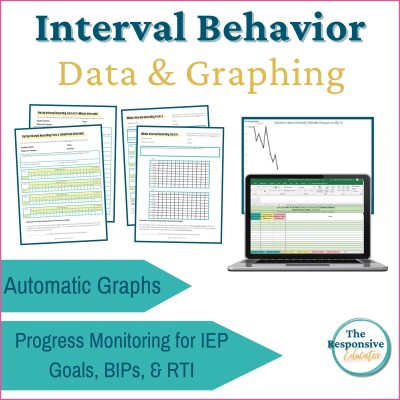
That is why I created my Interval Behavior Data Tracking Sheet and Digital Graphing Tool. It includes partial interval recording and whole interval recording forms, five-minute and ten-minute observation options, automatic Excel and Google Sheets graphing, an example graph with trend and phase lines, quick Excel tips, and an overview to help you decide when interval recording is the right choice.
The graphs update automatically as you enter the daily percentages. This makes it easier to identify trends, monitor intervention effectiveness, and share clear visual data during IEP meetings, behavior team discussions, and progress reports. Instead of spending your planning time building an interval chart, you can focus on what the data may be telling you and whether the student’s support needs to change.
If you are building a complete behavior data system, this resource works alongside my frequency, duration, and rate data collection and graphing resources. They are also included in my Behavior Data Collection and Graphing Bundle, which provides a connected system for choosing a measurement method, collecting behavior data, graphing progress, and making informed instructional decisions.
Interval recording recognizes an important reality of the classroom: sometimes a behavior happens too frequently to count accurately, and sometimes the question is whether a student can maintain a skill over time.
Partial interval recording can help you estimate how consistently a behavior appeared during an observation. Whole interval recording can help you determine whether a student sustained a target behavior throughout each interval. Neither method tells the entire story, but each can provide meaningful information when its scoring rules match the question you are asking.
As with every behavior measurement method, the goal is not to collect data for the sake of completing paperwork. The goal is to understand what is happening, determine whether an intervention is helping, and make changes when the student is not progressing.
The numbers are only the beginning. Their real value comes from using them to understand students more clearly, improve the support adults provide, and teach the skills students need for greater independence in school and beyond.


Support your students’ individual needs with our exclusive Classroom Concerns Checklist.
Identify key concerns in areas like cognitive skills, communication, social/emotional behavior, and more.
Sign up now to receive instant access and valuable insights on addressing classroom concerns.
Don’t miss out, join our community today!

Support your students’ individual needs with our exclusive Classroom Concerns Checklist.
Identify key concerns in areas like:
…and more to help drive collaboration and problem-solving.
Sign up now to receive instant access and valuable insights on addressing classroom concerns.