If you have spent any time in a classroom, you have probably found yourself asking:
“Why does this student keep doing this?”
Maybe a student refuses to begin independent work every afternoon. Another argues whenever the class transitions to a new activity. Someone else completes an assignment successfully one day but struggles with the same type of work the next. You try one strategy, then another, but nothing seems to address the pattern consistently.
When challenging behavior interrupts instruction, it is understandable that our first concern is stopping it. We have lessons to teach, classrooms to keep safe, and many other students who need our attention. However, when stopping the behavior becomes our only goal, we can miss the information the behavior is giving us.
That is where ABC behavior can help. The ABC model gives teachers and teams a structured way to examine what happened before a behavior, what the student did, and what happened immediately afterward. Instead of reacting to one difficult incident or relying on assumptions, we begin gathering information that can help us understand the conditions under which a student is successful—and the conditions that make success more difficult.
In the previous article, Behavior Data Collection Examples: How to Measure Common Classroom Behaviors, we looked at frequency, rate, duration, and interval recording. Those methods answer questions about how often a behavior occurs, how long it lasts, or how consistently it occurs across an observation.
ABC data answers a different question.
Instead of asking only, “How much behavior occurred?” ABC behavior data helps us ask, “What was happening around the behavior?”
That distinction matters. A frequency count may tell you that a student refused work five times during the week. Duration data may tell you that those episodes resulted in 90 minutes without academic engagement. Neither measurement necessarily tells you whether the refusals consistently followed difficult writing assignments, unexpected transitions, public correction, or another situation.
ABC data adds context to the measurement. It does not replace frequency, rate, duration, or interval recording. Depending on the questions your team is trying to answer, you may need both.
ABC stands for Antecedent, Behavior, and Consequence. Together, these three pieces create what is commonly called the ABC model of behavior or the antecedent-behavior-consequence model.
The model gives educators a consistent way to organize observations:
You may hear slightly different terms used in schools, behavior programs, and Functional Behavior Assessment meetings. Some people refer to antecedents and consequences, while others use phrases such as ABC behavior, ABC data, or the antecedent-behavior-consequence model. The basic purpose remains the same: examining the relationship among what happened before, during, and after a behavior.
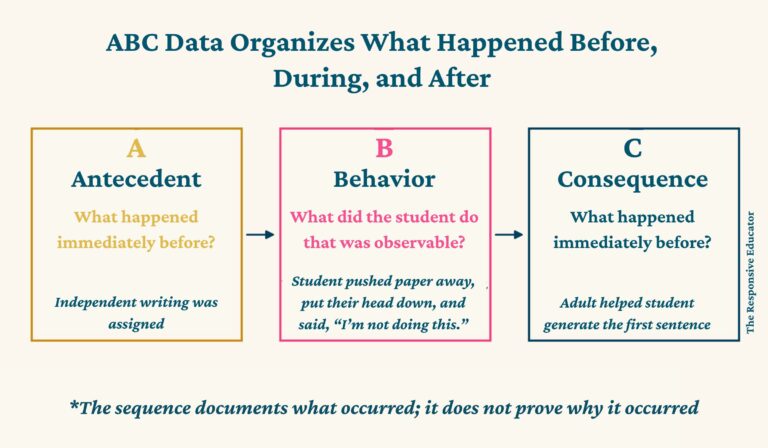
The antecedent is the event, activity, interaction, or situation that occurred immediately before the behavior.
Common classroom antecedents may include:
An antecedent is not necessarily the cause of the behavior. It simply identifies what was happening immediately before the student responded.
Consider a teacher who says, “Please take out your math books,” followed by a student throwing a pencil. The direction is the antecedent because it occurred immediately before the behavior. That does not mean teachers should stop giving directions or that the direction caused the student to throw the pencil.
As more observations are collected, the team may discover that the student struggles whenever independent math begins, whenever work appears difficult, or whenever the student believes they may make a mistake. Those are different patterns that would lead the team to ask different questions.
Antecedents are not automatically negative. They are simply the events that occur before behavior. Looking at one antecedent rarely tells us very much, but repeated antecedents across several observations may help identify situations in which a student is consistently successful or has greater difficulty.
The behavior is the specific, observable action the student demonstrates.
This is an area where teachers can unintentionally make their documentation less useful. When we are frustrated, busy, or trying to remember an incident at the end of a long day, it is easy to record our interpretation instead of describing what actually happened.
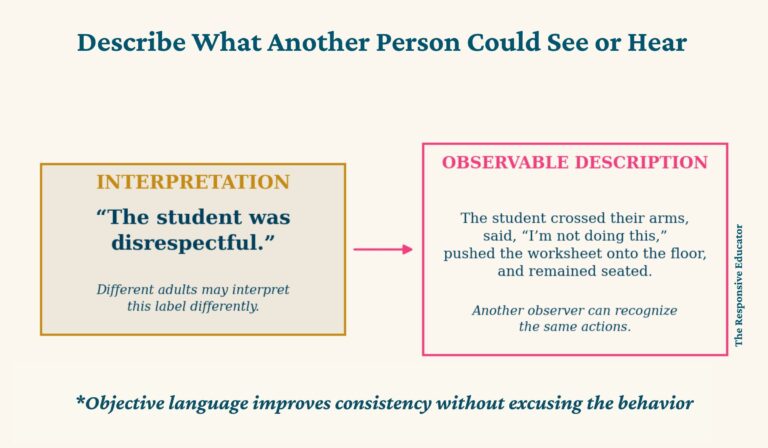
Compare these two descriptions:
The second description is more useful because it identifies actions another person could see or hear. If another teacher had been standing in the room, that teacher should be able to read the description and recognize the same behavior.
Words such as disrespectful, defiant, lazy, and unmotivated describe how an adult may interpret the student’s actions. They do not tell us exactly what the student did. Two educators may disagree about whether a student was being disrespectful, but they are much less likely to disagree about whether the student pushed a worksheet onto the floor, walked away from a desk, or shouted across the room.
Objective descriptions do not excuse the behavior or remove expectations. They give the team clearer information so everyone is discussing the same concern. This keeps meetings focused on solving the problem rather than debating the student’s intentions.
The word consequence creates a great deal of confusion when teachers first learn about ABC behavior. In everyday classroom language, we often use consequence to mean a punishment, disciplinary response, or loss of a privilege.
Within the ABC model, a consequence is simply what happened immediately after the behavior. For example:
Each example includes a consequence because something happened immediately after the behavior. The consequence is not necessarily good or bad, and recording it does not mean the teacher responded incorrectly. At this stage, we are documenting what occurred rather than judging the response.
Consequences matter because what happens after a behavior can influence whether it is more or less likely to occur again. Some consequences strengthen appropriate behaviors we want students to continue using. Others may unintentionally make challenging behavior more effective for the student.
This does not mean teachers should blame themselves when challenging behavior occurs. Behavior is complex, and many factors affect how a student responds. However, understanding what consistently happens afterward gives the team another important piece of information. It can help us decide which adult responses are working, which may need to change, and what additional skills or supports the student may need.
Each part of the ABC model provides useful information, but the real value comes from examining the three parts together across multiple observations.
Imagine a student who frequently refuses independent writing assignments. If we focus only on the behavior, we might conclude that the student does not like writing or is unwilling to work.
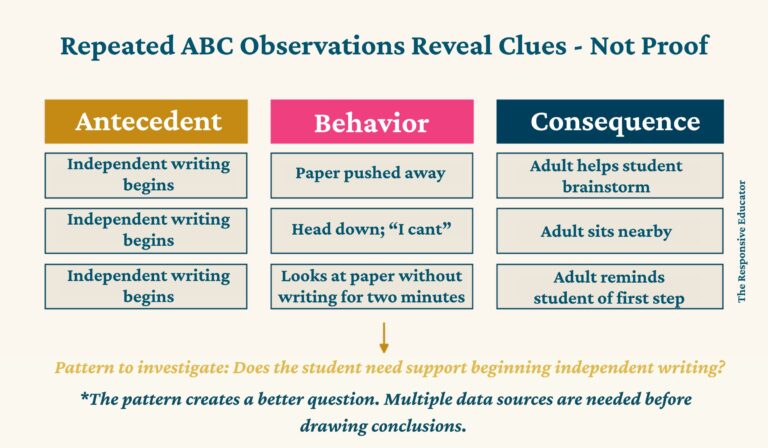
After collecting ABC information for several days, a more specific pattern begins to appear:
Now the team has better questions to investigate. Is getting started the most difficult part? Does the student need explicit support with planning or organizing ideas? Is the writing task above the student’s current skill level? Does the student lack confidence and rely on adult reassurance before beginning?
The ABC information does not answer those questions with certainty. It points the team toward possibilities that deserve further investigation.
That is one of the most valuable parts of the ABC model. It encourages us to become curious before reaching conclusions. Rather than assuming the student “just does not want to write,” we begin considering the academic skills, executive functioning skills, communication needs, environmental conditions, and adult responses that may be contributing to the pattern.
At first glance, ABC behavior may seem similar to ordinary documentation. Teachers already complete incident reports, office referrals, anecdotal notes, and communication logs. If you are already recording behavior, it is reasonable to wonder what makes ABC data different.
Traditional documentation often creates a record of what happened. ABC behavior documentation is designed to help a team examine the context surrounding what happened.
Suppose a student leaves their seat several times a day. If the only information recorded is that the student was out of their seat, we know the behavior occurred, but we do not know what the class was doing, what happened immediately beforehand, or how the adults and students nearby responded.
ABC behavior data encourages us to capture those additional details. Across several observations, the team may notice that the behavior occurs primarily during independent writing, rarely occurs during small-group instruction, or consistently results in one-on-one adult attention.
One isolated incident may not mean very much. Students have difficult moments for many reasons. They may be tired, worried, physically uncomfortable, distracted by something that happened earlier, or struggling with a task that is harder than it appears.
The team is looking for consistency:
I think of ABC data as gathering clues rather than proving a theory. Every observation gives us another piece of information, but we need multiple pieces before we can begin seeing a reliable pattern.
Many teachers first encounter ABC behavior when they are asked to collect data for a student who is being considered for a Functional Behavior Assessment. That can make ABC data feel like one more form required by someone outside the classroom.
In practice, ABC information can help at several stages of the behavior-support process. Teachers may use it to communicate concerns during problem-solving meetings, provide objective examples to a student support team, examine why previous classroom supports have not been effective, or contribute information to an FBA.
The classroom teacher is often in the best position to notice when and where a behavior occurs because that teacher sees the student across different tasks, routines, peer interactions, and instructional formats. At the same time, teachers should not feel they are expected to conduct a complete behavior analysis independently.
ABC data is most useful when it becomes part of a collaborative process. General and special education teachers, paraprofessionals, behavior specialists, school psychologists, related service providers, families, and the student may each have information that contributes to a clearer understanding of the concern.

ABC data is an important source of information during many Functional Behavior Assessments, but an ABC chart is not an FBA.
A comprehensive FBA may include:
Each source answers a different question. ABC data helps identify what happened before, during, and after specific incidents. Interviews may provide information about patterns across settings or circumstances that an observer has not seen. Academic data may reveal that a behavior occurs when a task requires skills the student has not yet mastered.
When several sources point in the same direction, the team can develop a better-supported hypothesis about the function of the behavior. That hypothesis can then guide the development of interventions and the teaching of replacement skills.
ABC data contributes clues. The full FBA process brings those clues together with other evidence.
Several misconceptions can make ABC data less useful or lead teams toward conclusions the information does not support.
Because the antecedent happened immediately before the behavior, it is easy to assume it caused the behavior. That conclusion goes beyond what the observation tells us.
The antecedent identifies the situation in which the behavior occurred. Repeated observations may eventually show that a behavior is more likely during particular tasks, interactions, or routines, but the antecedent alone does not explain why the student responded that way.
One ABC observation is like reading a single page from the middle of a book. You know what happened on that page, but you do not yet understand the larger story.
Meaningful patterns develop over time. Collecting observations across different days, activities, adults, and settings helps the team separate a one-time difficult moment from a pattern that deserves further investigation.
ABC data provides clues about why a behavior may be occurring, but it does not automatically establish the function. A repeated consequence may suggest a possibility without proving it.
For example, a student may regularly receive adult assistance after refusing writing work. That pattern could suggest that adult attention is important. It could also indicate that the student does not know how to begin the assignment without instructional support.
ABC data helps us develop better questions and possible hypotheses. The FBA process helps the team evaluate those possibilities using multiple sources of information.
Within the ABC framework, a consequence is not a synonym for discipline. It is whatever happens immediately after the behavior.
That may include a correction, attention, assistance, a change in the task, access to an item, peer laughter, additional practice, or reinforcement for an appropriate replacement behavior. Understanding this broader definition is necessary before teachers can collect accurate ABC data.
The ABC model does not give teachers a simple formula that explains every behavior. Students are too complex for that. What it does provide is a way to slow down, observe carefully, and replace assumptions with better questions.
Instead of asking only, “How do I make this behavior stop?” we begin asking:
Those questions lead to stronger decisions because they keep the focus on understanding the student rather than simply reacting to the behavior.

nderstanding the Antecedent Behavior and Consequence (ABC) model is the foundation. Once you know what antecedents, behaviors, and consequences are, the next step is learning how to record that information consistently without turning every behavior incident into a lengthy narrative.
In the next article, What Is an ABC Behavior Chart?, we will look at the tool teachers and teams use to organize these observations. I will explain what an ABC chart is, what information it can collect, when it is useful, and how it fits into the larger behavior-support process.
ABC behavior gives us a structured way to examine what happened before, during, and after a student’s behavior. More importantly, it helps us move away from assumptions and toward curiosity.
The goal is not to excuse unsafe or inappropriate behavior, eliminate expectations, or avoid accountability. The goal is to understand what is making success difficult so we can teach the missing skills, adjust the conditions adults can change, and provide support that helps the student respond more successfully.
Behavior documentation has value when it leads to greater understanding. When that understanding helps a student develop the communication, regulation, academic, or independence skills they need, the data becomes much more than paperwork.


Support your students’ individual needs with our exclusive Classroom Concerns Checklist.
Identify key concerns in areas like cognitive skills, communication, social/emotional behavior, and more.
Sign up now to receive instant access and valuable insights on addressing classroom concerns.
Don’t miss out, join our community today!