“I’ve been told I need to collect behavior data…but nobody has ever explained what kind of data I should collect.”
I’ve heard versions of that statement from countless teachers. They know they should be documenting behavior, but they are often handed a data sheet without much explanation about what that particular method measures or how the information will be used. This can leave teachers collecting numbers without feeling confident that those numbers actually answer the question they are trying to ask.
Frequency count is often one of the best places to begin. It is practical, easy to understand, and manageable in a busy classroom. You define the behavior, record one tally each time it occurs, and compare the totals across observation periods. When a behavior has a clear beginning and end, frequency count can give you exactly the information you need to establish a baseline, monitor progress, and evaluate whether an intervention is making a difference.
Imagine that you are tracking a student who calls out during a 30-minute math lesson. At the end of the lesson, you record 18 occurrences. That frequency count gives you clear, useful information because the question you are trying to answer is, “How often is this behavior happening?”
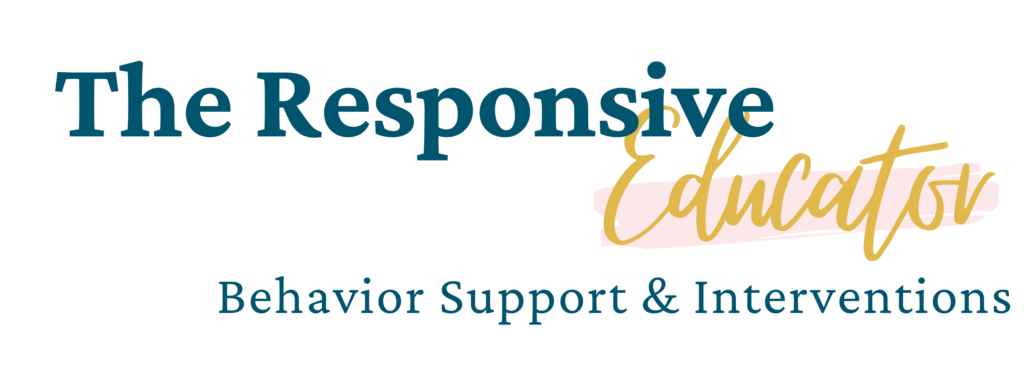
The important part is recognizing what frequency count is—and is not—designed to measure. Suppose another student has three tantrums during the week. Three incidents may not sound especially concerning until you realize that each tantrum lasted approximately 45 minutes. The frequency count is accurate, but duration would communicate the effect on the student and the classroom more clearly.
That does not make frequency count a weak measurement method. It makes it a precise one. Frequency count answers the question “How many times did the behavior occur?” extremely well. The key is making sure that is the question you actually need your data to answer.
Whenever I review behavior data, I ask:
“If someone else looked at this information, would they understand what has been happening?”
When frequency count provides that clear picture, it is one of the simplest and most useful behavior measurement methods available. In this post, we will look at which behaviors are a good fit for frequency count, how to collect the data without interrupting instruction, how students can use it for self-monitoring, and how to recognize when another measurement method may provide more useful information.
Frequency count is a useful method for measuring behavior in situations where the behavior is easily observable and measurable. For example, behaviors like completing assignments, raising one’s hand to ask a question, or engaging in off-task behavior can all be easily counted and tracked using frequency count. Tracking the frequency of behaviors can be effective when collecting behavioral baseline data and for use in functional behavior assessments, as well as for progress monitoring behavior intervention plans.
As always, it’s vital to clearly define the behavior you will be tracking to ensure consistency and accuracy in data collection. If you need help operationally defining target behaviors, see this post: How to Use Behavioral Baseline Data to Set Realistic Goals and Measure Success.
One of the key advantages of using frequency count is its simplicity and ease of use. With this method, teachers can quickly and easily gather data on student behavior, even in busy or complex classroom environments. This makes it an ideal approach for teachers who are looking for a straightforward way to track behavior and make data-driven decisions.
There are many examples of how frequency count can be used in the classroom. For instance, teachers can use this approach to track positive behaviors like active engagement or participation in class discussions, as well as negative behaviors like talking out of turn or disruptions.
Before deciding whether frequency count is the right measurement method, it’s important to make sure you’re measuring a behavior that can actually be counted.
Frequency count measures observable behaviors, not opinions or interpretations. For example, you can’t accurately count behaviors such as:
Those words describe our interpretation of a student’s behavior rather than something everyone can objectively observe. If five adults watched the same student, they might disagree about whether the student was being “disrespectful,” which means they would also collect different data.
Instead, ask yourself a different question:
“What did you see the student do?”
Now you’re describing behaviors that can be counted consistently. Instead of measuring disrespect, you might define and count behaviors such as:
Those are behaviors that another teacher, paraprofessional, or administrator could recognize and count in exactly the same way.
If you’re struggling to turn a broad concern into a clearly measurable behavior, it is a good idea to start by writing an observable behavior definition before you begin collecting data. My article on Behavioral Baseline Data walks through that process and explains how clear behavior definitions improve the accuracy of every type of behavior data you collect.

Not every behavior should be measured with frequency count, but when the behavior fits the method, it is one of the easiest and most effective ways to monitor progress. If you are still comparing measurement options, start with Behavior Data Collection: How to Choose the Right Measurement Method. That earlier post explains what each method measures; this one helps you decide whether frequency count fits the specific behavior in front of you.
As a general rule, I begin thinking about frequency count when I can answer yes to these questions:
If the answer to all three questions is yes, frequency count is probably a good choice.
Here is a simple frequency ABA example. Suppose you define calling out as speaking during instruction without being called on, then observe a 30-minute math lesson. If the student calls out 12 separate times, the frequency count for that lesson is 12.
This is also an example of frequency in ABA because you are counting separate, observable responses during a defined observation period. The number becomes useful when you collect it consistently across comparable lessons. You can then see whether the behavior is increasing, decreasing, or staying about the same after support is introduced.
Frequency count works especially well for behaviors that happen quickly and can easily be separated into individual events.
Examples include:
Each occurrence begins, ends, and can be counted before the next one happens.
One mistake I sometimes see is teachers thinking behavior data should only document problem behaviors.
Some of the most meaningful data I’ve collected has measured the behaviors we were trying to increase rather than decrease.
For example, you might use frequency count to track:
Measuring replacement behaviors often tells a much more encouraging story than simply documenting what students are doing wrong. It also keeps everyone focused on the skills you’re trying to teach instead of only the behaviors you’re trying to eliminate.
Although frequency count is commonly associated with behavior, it can also be an effective way to monitor academic skills when you’re counting individual events.
For example, teachers might track:
The same measurement method can be used whenever you’re counting clearly defined, observable events.

One of the first questions teachers usually ask after deciding to use frequency count is, “How am I supposed to keep track of this while I’m teaching?”
It’s a fair question. Most teachers aren’t sitting quietly observing one student all day. You’re teaching lessons, answering questions, managing transitions, helping small groups, and responding to the unexpected. Any data collection system that requires your full attention simply isn’t going to be practical in a real classroom.
The good news is that frequency count is one of the easiest behavior measurement methods to collect during instruction. Because you’re only recording each occurrence, the system can be as simple or as sophisticated as you need it to be. The best tool is usually the one you’ll actually use consistently.
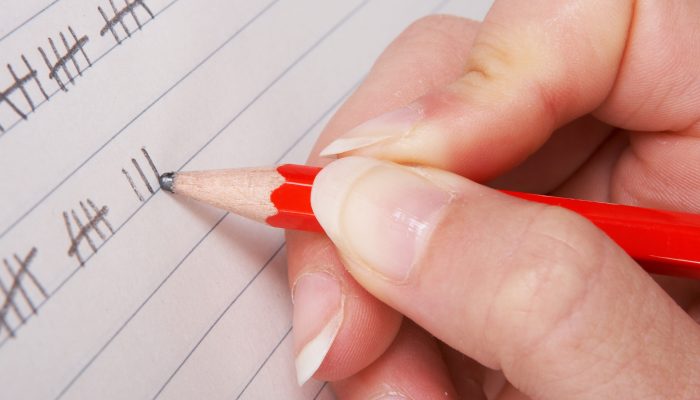
Many teachers begin with nothing more than a clipboard and a behavior frequency chart. A simple behavior frequency data sheet gives you a place to make one tally mark each time the behavior occurs, then continue teaching. Sometimes that is all you need.
If you are moving around the classroom or do not want to carry a clipboard, a small mechanical hand tally counter, or finger counter can make recording behaviors even easier. You simply press the button each time the behavior occurs without having to stop what you are doing.
The goal isn’t to have the fanciest data collection system. The goal is to have one that’s simple enough that you’ll continue using it consistently.
Many teachers also prefer digital behavior tracking tools.
Programs like ClassDojo allow teachers to quickly record behaviors while providing immediate feedback to students. Other behavior tracking platforms add game-like features that can increase student motivation and engagement. Because these programs change over time, it’s worth spending a few minutes comparing the options that best fit your classroom and teaching style.
Whether you choose paper, a click counter, or a digital app, the quality of your data depends much more on collecting it consistently than on the tool you use.

Frequency count isn’t only useful for teachers. It can also be an effective self-monitoring strategy that helps students become more aware of their own behavior.
One of my favorite examples involved a student who insisted he only called out during class “once in a while.” His teachers had a very different perspective. Rather than arguing about who was right, we decided to let the data answer the question.
Each time he called out without raising his hand, we added one tally mark. At the end of the lesson, we counted them together.
He was genuinely surprised.
Until that point, he wasn’t being dishonest. He simply wasn’t aware of how often the behavior was happening. Seeing the tally marks made the behavior concrete in a way that verbal reminders never had.
That simple frequency count became a self-monitoring tool rather than just a data collection form. Together, we began setting realistic goals and tracking his progress over time. As the number of tally marks decreased, he could see his own improvement on a behavior graph instead of relying on someone else to tell him he was doing better. The data shifted from being something adults collected about him to something we used with him.
I’ve found that self-monitoring can be especially effective for students who genuinely don’t realize how often a behavior occurs. It increases awareness, encourages student ownership, and provides objective feedback without turning every reminder into an argument. Instead of saying, “You’re calling out too much,” the data allows both the teacher and the student to look at the same information and work toward a shared goal.
Frequency count doesn’t always have to be something the teacher collects. For many students, it can become a powerful self-monitoring tool that increases self-awareness and encourages greater independence.
If you’re looking for ready-to-use self-monitoring charts, I’ve created a self-monitoring bundle that includes editable tracking forms for skills such as classroom participation, talking out, following directions, emotional regulation, on-task behavior, task completion, and more. Each chart is designed to help students reflect on their own behavior while giving teachers an easy way to review progress together.
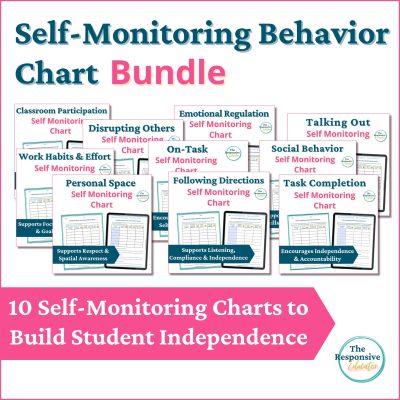
Frequency count is an excellent measurement method—but it isn’t designed for every behavior.
As you continue collecting behavior data, you’ll probably notice that some behaviors fit naturally into a frequency chart while others don’t. That’s normal. The goal isn’t to use frequency count every time. The goal is to recognize when another measurement method would give you more useful information.
One clue is that you find yourself adding a verbal explanation every time you share your data.
You might hear yourself saying:
“The frequency count doesn’t show how long the behavior lasted.”
“It doesn’t show how disruptive it was.”
“The numbers don’t really explain why we’re concerned.”
“There was a lot more happening than these tally marks show.”
If you’re regularly adding those kinds of explanations, your data is telling you something important. The behavior may need to be measured a different way.
Frequency count answers one question extremely well:
“How often did this behavior occur?”
If that’s no longer the question you’re trying to answer, consider whether another measurement method would be a better fit. If that is no longer the question you are trying to answer, another measurement method may be a better fit. Every behavior measurement method has a purpose. The goal is not to rely on one method for every situation, but to recognize which method best communicates what is happening in your classroom.
Even when frequency count is the right measurement method, a few common mistakes can make your data much less useful. Fortunately, they’re also easy to avoid once you know what to look for.
Before anyone begins collecting data, everyone needs to understand exactly what counts as one occurrence of the behavior.
I once worked with a student whose point sheet was tracking physical aggression. The behavior was clearly defined in his IEP, written directly on his point sheet, and explained to the classroom teacher both in an email and in person.
Despite that, she began taking points away for behaviors like “being rude” because she felt those behaviors should count too. The result was weeks of unusable data.
The issue wasn’t that she wasn’t trying to help. The issue was that we were no longer measuring the same behavior. When different adults collect data using different definitions, the numbers no longer represent the same thing. That makes it impossible to accurately evaluate student progress or determine whether an intervention is working.
If multiple teachers, paraprofessionals, or service providers are collecting data, take a few minutes to review the behavior definition together before you begin. Everyone should be measuring the same behavior in the same way.
Frequency count works best when each occurrence can be identified and counted separately.
If you find yourself wondering whether something should count as one occurrence or several, or you’re struggling to keep up with your tally marks because the behavior is happening almost continuously, it’s worth asking whether frequency count is really the best choice.
Remember, the goal isn’t to make the behavior fit the data sheet. The goal is to choose the data collection method that best fits the behavior.
Once you’ve started collecting data, consistency matters.
I remember sitting in a staff meeting at an alternative behavior school where everyone was celebrating because several maladaptive behaviors had decreased dramatically from the previous year. The problem was that the school had changed how those behaviors were defined. As I listened, I couldn’t help thinking that we were comparing apples to oranges. The data wasn’t necessarily showing improvement—we were simply measuring something different than we had the year before.
The same thing can happen when an individual student’s data collection changes. For example, you might begin by collecting a frequency count and later realize that duration recording would provide a much more accurate picture. That’s a good decision if the new measurement method better matches the behavior.
What you shouldn’t do is continue plotting both measurements on the same graph or compare them as though they’re measuring the same thing. Frequency and duration answer different questions, so they shouldn’t be interpreted as though they’re directly comparable.
If you decide another measurement method is more appropriate, don’t think of it as continuing the same set of data. You’re beginning a new measurement because you’re now measuring something different. Start a new graph and document why the change was made so everyone reviewing the data understands what changed.
Before choosing frequency count, ask yourself these three questions:
✔ Does the behavior have a clear beginning and end?
✔ Can I easily identify and count each occurrence?
✔ Am I trying to find out how often the behavior occurs?
If you answered yes to all three questions, frequency count is probably a good choice. If not, another measurement method may provide a clearer picture.
Remember, there isn’t one “best” behavior measurement method. The best method is the one that paints the clearest and most accurate picture of what’s happening so you can make informed decisions about how to support your student.
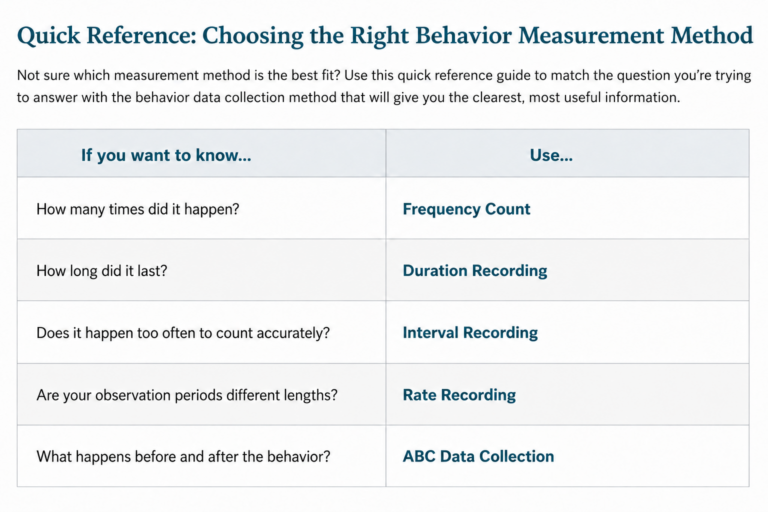
Once you’ve decided that frequency count is the right measurement method, the next step is choosing a recording system that’s simple enough to use consistently.
Some teachers prefer to create their own frequency charts, while others use digital behavior tracking tools or spreadsheets they have built themselves. The specific tool is not nearly as important as using a behavior frequency data collection system consistently enough to produce accurate information.
If you’d rather spend your time teaching than creating data sheets and spreadsheets, my Frequency Behavior Data & Graphing resource includes printable frequency recording forms, automatic graphs for both Excel and Google Sheets, examples, and guidance to help you organize and interpret your data. It’s designed to simplify behavior progress monitoring while still giving you meaningful information you can use to make instructional decisions.
If you’re supporting students who are learning to recognize and manage their own behavior, you may also be interested in my Self-Monitoring Charts. These editable charts help students track behaviors such as talking out, following directions, emotional regulation, on-task behavior, classroom participation, task completion, and other important classroom skills while encouraging independence and personal responsibility. They pair especially well with frequency count because students can see their own progress over time instead of relying entirely on adult feedback.
Frequency count is one of the simplest behavior measurement methods you’ll use, but using it well requires more than making tally marks. The real skill is recognizing when frequency count will communicate the behavior clearly and when another measurement method would provide a more complete picture.
As you become more comfortable collecting behavior data, you’ll probably find yourself thinking less about which form to use and more about whether the data accurately represents what’s happening in your classroom. That’s exactly the shift we’re aiming for. Good behavior data isn’t about completing paperwork. It’s about understanding students well enough to make informed decisions that improve their success.
As you continue building your behavior data collection skills, you’ll add more tools to your toolbox. Frequency count is one of the most useful, but it’s only one of several measurement methods that help us understand student behavior. The more accurately your data reflects what’s happening in the classroom, the more confidently you’ll be able to select interventions, monitor progress, communicate with families, and advocate for the support your students need.
If you are still deciding which behavior measurement method best fits your situation, read Behavior Data Collection: How to Choose the Right Measurement Method. Once you have collected several observations, continue to Behavior Frequency Chart: How to Graph and Interpret Your Data to learn how to turn those counts into a visual record and use the pattern to guide your next decisions.

Support your students’ individual needs with our exclusive Classroom Concerns Checklist.
Identify key concerns in areas like:
…and more to help drive collaboration and problem-solving.
Sign up now to receive instant access and valuable insights on addressing classroom concerns.
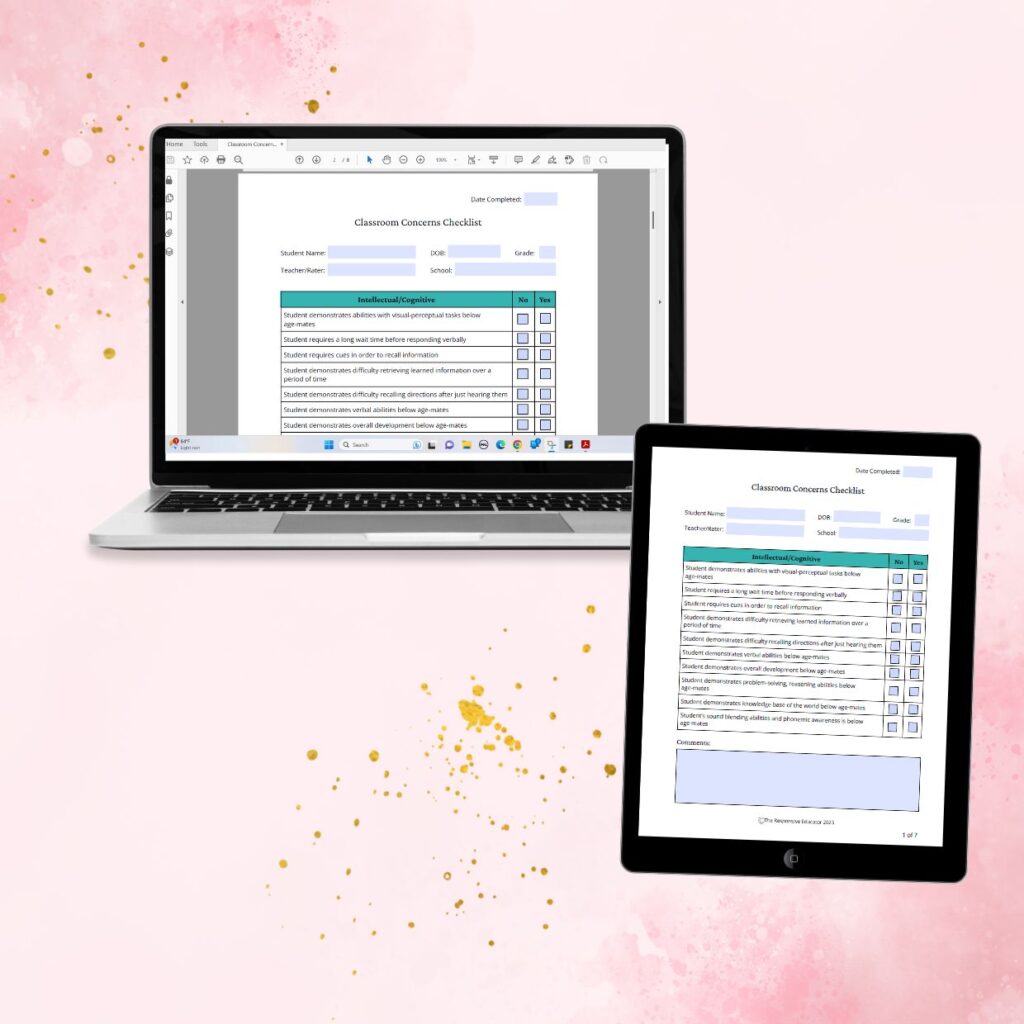
When a student is struggling, it can be difficult to know what information matters or what to look at next. The free Classroom Concerns Checklist can help you organize what you are seeing, identify patterns, and decide what information your team may need.