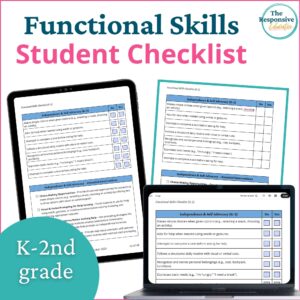


Description
The 9th-12th Grade Functional Life Skills Checklist helps special education and transition teams assess student skills, identify specific needs, select targeted interventions, and develop measurable IEP goals. This resource brings functional skills assessment, transition planning, intervention selection, goal writing, and optional progress monitoring together in one organized system.
High school functional skills affect much more than classroom performance. They influence a student’s ability to prepare for employment, advocate for accommodations, manage daily responsibilities, navigate the community, participate in postsecondary education, and use adult services.
A broad statement that a student “needs life skills” does not identify what the student needs to learn next. I created this resource to help teams move from that broad concern to specific, observable functional skills that can be taught, practiced, and monitored.
9th-12th Grade Functional Life Skills Checklist
Students approaching adulthood may follow very different pathways. One student may be preparing to manage most daily responsibilities independently. Another may be working toward greater participation and self-advocacy while continuing to use adult assistance, structured guidance, or environmental supports.
This informal functional skills assessment helps educators identify those differences. It provides a structured way to document strengths, identify skill gaps, and determine appropriate instructional and transition priorities.
Teams can use the results to:
- Identify functional skill strengths and needs
- Establish informal baseline information
- Select transition-related instructional priorities
- Choose targeted interventions
- Develop individualized IEP goals
- Document observations and progress
- Support IEP, BIP, MTSS, and transition planning
- Improve collaboration among school staff, families, service providers, and adult-support agencies
Independent and Supported Tracks
The high-school version includes two tracks:
- Independent Track: For students working toward completing functional tasks with minimal assistance
- Supported Track: For students expected to continue using accommodations, prompting, structured guidance, or adult support
The two-track format recognizes that adult independence does not look the same for every student. A meaningful goal may focus on completing a task independently, completing part of a task, communicating the need for assistance, participating with support, or using an accommodation effectively.
Teams can select the track that best reflects the student’s needs and use information from both tracks when appropriate.
What’s Included
This resource includes:
- Functional life skills checklists developed for Grades 9–12
- Independent and Supported tracks
- Fourteen functional skill areas
- Developmentally appropriate student skill indicators
- Targeted intervention ideas aligned with each area
- Measurable sample goals
- Notes and comments sections
- Optional tracking sheets
- Printable and digital tracking options
The aligned structure helps educators move from identifying a need to planning instruction and monitoring progress toward transition outcomes.
Fourteen Functional Life Skill Areas
The resource addresses:
- Community Navigation and Safety
- Daily Living Skills
- Employment and Job Readiness
- Independence and Self-Advocacy
- Meal Preparation and Nutrition
- Medical and Health Management
- Motor Skills and Safety Awareness
- Personal Finance and Money Management
- Play and Leisure Skills
- Pre-Academic and Academic Readiness
- Self-Care Skills
- Self-Regulation and Emotional Control
- Social Skills and Communication
- Toileting Skills
These areas help teams consider the whole student. The Grades 9–12 indicators address abilities that may affect employment, community access, postsecondary education, supported or independent living, personal safety, and quality of life.
Employability Skills and Job Readiness
Employment preparation involves more than completing assigned work. Students may need instruction in:
- Following workplace routines
- Arriving prepared and on time
- Communicating with supervisors and coworkers
- Asking for clarification
- Accepting feedback
- Completing tasks at an appropriate pace
- Managing emotions in workplace situations
- Using accommodations appropriately
- Recognizing safety expectations
- Demonstrating responsibility and persistence
The checklist helps teams identify the specific employability skills that require support rather than treating job readiness as one broad ability.
Targeted Functional Skills Interventions
After identifying a skill need, educators can review interventions aligned with that area. Depending on the skill and student pathway, recommendations may include:
- Explicit instruction and modeling
- Visual, written, or technology-based supports
- Task analysis
- Guided practice in realistic settings
- Prompting and prompt fading
- Environmental adaptations
- Self-monitoring systems
- Role-play and rehearsal
- Community-based instruction
- Supported decision-making
- Self-advocacy practice
- Job-readiness instruction
- Emotional-regulation supports
- Collaboration with families and service providers
The intervention lists provide starting points. Teams can select and adapt supports based on the identified skill, environment, student preferences, and anticipated adult needs.
Measurable Functional Life Skills IEP Goals
The sample goals connect directly to the functional skills assessed. Educators can adjust the setting, prompting level, frequency, performance criteria, and expected level of independence to match the student’s baseline and transition needs.
The goals may support instruction related to:
- Daily living routines
- Employability and job readiness
- Communication
- Self-care
- Personal and community safety
- Emotional regulation
- Social participation
- Self-advocacy
- Money management
- Organization and responsibility
- Community navigation
- Independent or supported adult functioning
Connecting the checklist, interventions, and goals makes it easier for teams to explain what the student needs, why a goal was selected, and how that skill connects to the student’s postsecondary plans.
Use This Resource for Transition and IEP Planning
Use the 9th-12th Grade Functional Life Skills Checklist to:
- Prepare for IEP and transition meetings
- Organize observations from multiple team members
- Identify transition-related instructional priorities
- Select individualized interventions
- Draft measurable functional IEP goals
- Document informal baseline performance
- Plan direct life-skills and employability instruction
- Review progress across reporting periods
- Communicate with families and service providers
- Support preparation for employment, community participation, postsecondary education, and adult living
Who This Resource Is For
This resource is designed for professionals supporting high-school students, including:
- Special education teachers
- Transition coordinators
- Behavior specialists
- School psychologists
- Interventionists
- Occupational therapists and related-service providers
- Self-contained classroom teams
- Vocational and community-based instruction programs
- IEP, BIP, MTSS, and transition teams
It can be used in self-contained, resource, inclusion, vocational, community-based, and transition-focused settings.
Important Assessment Information
This resource is an informal educational assessment and planning tool. It is not standardized, norm-referenced, or diagnostic. It does not replace a formal evaluation, functional behavior assessment, comprehensive transition assessment, or other individualized assessment when one is required.
The checklist, interventions, and sample goals should be individualized based on the student’s needs, baseline performance, environment, transition pathway, preferences, and anticipated level of adult support.
The purpose is not to hold every student to one definition of independence. It is to help the team identify meaningful next steps and plan instruction that supports the greatest appropriate level of participation, self-determination, and independence.
Reviews
There are no reviews yet.