


Description
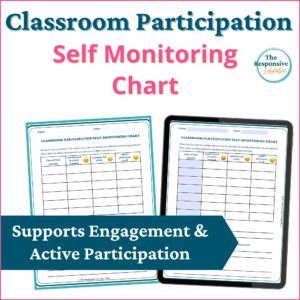
Disruptive behavior in the classroom can continue even after expectations have been taught and reminders have been given. Some students do not consistently recognize when their actions are distracting classmates, interrupting learning, or requiring repeated adult redirection. This self-monitoring checklist and classroom behavior tracker helps students examine their behavior across the school day, reflect on patterns, and choose a realistic goal for improvement.
Students use a simple three-level smiley-face scale to rate how well they respected others’ learning during six or seven classes, activities, or time periods. Teachers can review the completed tracker with the student, compare the student’s ratings with their own observations, and discuss what may help the student participate more successfully.
Help Students Recognize Disruptive Behavior in the Classroom
“Stop disrupting the class” may be clear to an adult, but it does not always help a student recognize the specific behavior that needs to change. Classroom disruptions may include making noises, involving classmates in off-task behavior, moving around at inappropriate times, playing with materials, interrupting instruction, or repeatedly drawing attention away from an activity.
Before using the checklist, clearly define what respecting others’ learning looks like for the student. Expectations might include:
- Using materials appropriately
- Keeping noises at an appropriate level
- Remaining in the expected area
- Waiting for an appropriate time to interact with classmates
- Following the activity without distracting others
- Responding to a reminder and returning to the expected behavior
The goal is not to label the student as disruptive. It is to help the student identify observable actions, understand how those actions affect the classroom, and practice making a different choice.
Classroom Behavior Tracker for Student Self-Monitoring
Students rate their behavior during each activity or time period using three options:
- Stayed focused
- Needed a few reminders
- Often distracted others
These quick ratings can help students notice whether disruptions are more likely during certain subjects, groupings, activities, or times of day. A student may have difficulty during independent work but respond successfully during small-group instruction. Another may do well early in the day but need more support during transitions or less-structured activities.
The completed classroom behavior tracker gives the teacher and student a concrete place to begin the conversation. It does not replace teacher observation or formal behavior data, but it provides useful student-reported information that can be considered alongside adult observations.
Use Student Behavior Self-Assessment to Build Awareness
Students cannot independently change behavior they do not yet recognize. This student behavior self-assessment asks students to pause, consider their actions, and identify how much adult support they needed.
At the end of the day, students reflect on:
- What helped them stay focused
- What they can do differently tomorrow
An optional teacher-notes section provides space for feedback, observations, or follow-up information. Teachers can use this section to acknowledge progress, clarify differences between the student’s rating and the teacher’s observation, or identify a strategy to practice the next day.
Move Beyond Repeated Redirection
Repeated reminders may stop a disruption briefly without helping the student understand the pattern. Self-monitoring shifts part of the process from adult correction to student awareness.
During a brief review, the teacher can help the student consider:
- When it was easiest to respect others’ learning
- When reminders were needed
- What was happening before a disruption
- Which strategy helped the student return to the activity
- What one attainable goal could be used the next day
A goal might focus on keeping materials in the assigned area, using an appropriate voice, returning to work after one reminder, or waiting until an appropriate time to interact with a classmate.
When a Disruptive Behavior Checklist May Help
This resource may be useful for students who:
- Frequently distract classmates
- Need repeated reminders during instruction or independent work
- Struggle to recognize how their actions affect others
- Demonstrate impulsive classroom behavior
- Can follow expectations but need help doing so more consistently
- Are learning to reflect on and monitor their own behavior
- Have classroom-behavior goals included in an IEP, 504 Plan, MTSS plan, BIP, or other support plan
Self-monitoring works best when the student understands the expectation and can demonstrate the skill with support. If the student does not yet know what to do instead, the replacement behavior should be explicitly taught, modeled, practiced, and reinforced. The checklist is a tool for building awareness and independence—not a substitute for instruction or an appropriate individualized intervention.
Use for Behavior Support and Progress Discussions
This classroom behavior checklist can be used during:
- IEP or 504 Plan support
- MTSS or RTI interventions
- Behavior intervention plans
- Check-in/check-out routines
- Counseling or behavior-support sessions
- Teacher-student conferences
- Individual reflection and goal setting
- Informal progress reviews
- Home-school communication
The tracker can be completed independently or reviewed with a teacher, counselor, paraprofessional, case manager, or other support person.
Printable and Digital Classroom Behavior Checklist
Two versions are included so teachers can select the format that fits the student’s schedule:
- Six-activity or time-period tracker
- Seven-activity or time-period tracker
Print the checklist for students to complete by hand, or use the digital PDF with type-in fields for the activity or time-period labels.
Please note: The digital version includes editable activity or time-period fields. The directions, rating categories, reflection questions, graphics, colors, and overall layout are not customizable.
What’s Included in the Disruptive Behavior in the Classroom Checklist
- Six-activity or time-period classroom behavior tracker
- Seven-activity or time-period classroom behavior tracker
- Three-level smiley-face self-monitoring scale
- Daily student-reflection questions
- Student goal-setting prompt
- Optional teacher-notes section
- Printable PDF
- Digital PDF with editable activity or time-period fields
This disruptive behavior checklist gives students a structured way to recognize patterns, consider how their actions affect other people, and take a more active role in working toward respectful classroom behavior.
Reviews
There are no reviews yet.