

Description
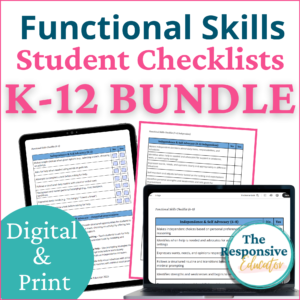
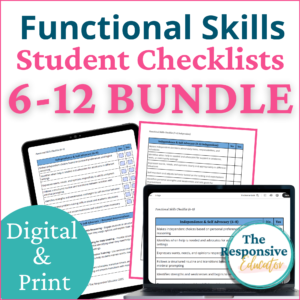
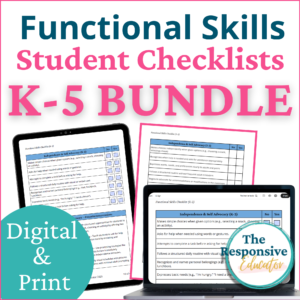
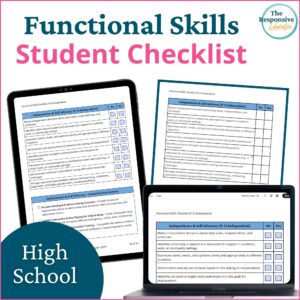
The K-2nd Grade Functional Life Skills Checklist helps special education teams assess foundational skills, identify specific student needs, select targeted interventions, and develop measurable IEP goals. This 48-page resource brings the checklist, intervention-planning, and goal-writing process together in one organized system.
Students who struggle with routines, communication, self-care, emotional regulation, or independence may need more than repeated reminders. Before deciding what intervention to use, educators need to identify the specific skill the student has not yet developed.
I created this resource to help teams move from broad concerns such as “needs to be more independent” to specific, observable skills that can be taught, practiced, and monitored.
K-2nd Grade Functional Life Skills Checklist
A student described as “not independent” may actually need support with several different skills. One student may have difficulty asking for help. Another may need explicit instruction in bathroom routines, staying with a group, managing frustration, making simple choices, or completing an age-appropriate self-care task.
This informal functional skills assessment separates those broad concerns into specific skills. The checklist helps educators document student strengths, identify areas needing instruction, and determine what to teach next.
Educators can use the results to:
- Identify functional skill strengths and needs
- Establish informal baseline information
- Select priorities for direct instruction
- Choose targeted interventions
- Develop individualized IEP goals
- Document observations and progress
- Support IEP, BIP, and MTSS discussions
- Improve collaboration among teachers, families, and service providers
What’s Included
This 48-page resource includes:
- Developmentally appropriate functional life skills checklists
- Fourteen functional skill areas
- Yes-or-no rating options
- Targeted intervention ideas aligned with each area
- Measurable sample goals that can be individualized
- Space for notes, observations, and documentation
- Fillable PDF fields for digital use
- Printable pages for handwritten use
The PDF can be completed digitally or printed and completed by hand.
Fillable PDF clarification: Fillable means the existing fields can be completed digitally. The wording, layout, fonts, colors, and design are not customizable.
Fourteen Functional Life Skill Areas
The checklist addresses:
- Community Navigation and Safety
- Daily Living Skills
- Employment and Job Readiness
- Independence and Self-Advocacy
- Meal Preparation and Nutrition
- Medical and Health Management
- Motor Skills and Safety Awareness
- Personal Finance and Money Management
- Play and Leisure Skills
- Pre-Academic and Academic Readiness
- Self-Care Skills
- Self-Regulation and Emotional Control
- Social Skills and Communication
- Toileting Skills
These areas allow teams to consider the whole student rather than focusing only on classroom behavior or academic performance. The K–2 indicators address early abilities related to communication, safety, participation, self-management, and emerging independence.
Targeted Functional Skills Interventions
Identifying a missing skill is useful only when the team knows what to do next. Each checklist area includes potential interventions that educators can select and adapt to the student’s needs.
Depending on the skill, intervention ideas may include:
- Explicit teaching and modeling
- Visual directions and schedules
- Guided practice
- Task analysis and step-by-step instruction
- Prompting and prompt fading
- Reinforcement
- Social stories and role-play
- Environmental supports
- Supported choice-making
- Practice across people and settings
- Self-regulation supports
The intervention lists are not intended to create the same plan for every student. They provide practical starting points for selecting supports that address the student’s identified skill needs.
Measurable Functional Life Skills IEP Goals
The included sample goals connect directly to the functional skills assessed. Teachers can adjust the setting, prompting level, frequency, performance criteria, and expected degree of independence to reflect the student’s baseline and individual needs.
The goals may support instruction related to:
- Daily living skills
- Communication
- Self-care
- Personal and community safety
- Emotional regulation
- Social participation
- Self-advocacy
- Early responsibility
- Classroom independence
Because the goals align with the checklist areas, teams can more clearly explain why a goal was selected and what skill the student is working to develop.
Use This Resource for Assessment and Planning
The K-2nd Grade Functional Life Skills Checklist can be used to:
- Prepare for IEP and student-support meetings
- Organize observations from multiple team members
- Identify instructional priorities
- Select individualized interventions
- Draft measurable functional IEP goals
- Document informal baseline performance
- Plan direct life-skills instruction
- Review progress across reporting periods
- Communicate with families and service providers
- Support transitions between teachers, classrooms, or programs
Who This Resource Is For
This resource is designed for professionals supporting early elementary students, including:
- Special education teachers
- General education teachers in inclusive classrooms
- Behavior specialists
- School psychologists
- Interventionists
- Occupational therapists and related-service providers
- Self-contained classroom teams
- IEP, BIP, and MTSS teams
It can be used in self-contained, resource, inclusion, and general education settings whenever a student needs additional instruction in functional life skills.
Important Assessment Information
This resource is an informal educational assessment and planning tool. It is not standardized, norm-referenced, or diagnostic. It does not replace a formal evaluation, functional behavior assessment, or other individualized assessment when one is required.
The checklist, interventions, and sample goals should be individualized based on the student’s needs, baseline performance, environment, and required level of support.
The purpose is not simply to document whether a student can or cannot perform a skill. It is to help the team identify what the student needs to learn next and plan instruction that supports meaningful independence over time.
Reviews
There are no reviews yet.