

Description
These respecting rules and boundaries behavior reflection sheets help students examine choices involving personal space, safety, property, technology, restroom privileges, classroom materials, and expectations with substitute teachers. The resource includes seven targeted behavior think sheets that guide students through what happened, how others were affected, and what they can do differently next time.
Rules and boundaries can seem unrelated on the surface, but they all involve recognizing limits. Students need to understand which materials they may use, how close they should stand to someone, where they can move safely, and whether an action affects another person’s belongings, privacy, comfort, or ability to learn.
I designed these sheets to help students move beyond being told that they “crossed a line.” Each reflection provides a structured way to identify the boundary, understand why it matters, and develop a practical response for a similar situation.
Teaching Students to Respect Rules and Boundaries
Telling a student to “respect boundaries” assumes that the student recognizes the boundary and knows what to do instead. Some students need more explicit instruction in reading social cues, asking permission, following safety expectations, or applying familiar rules when the regular teacher is not present.
Each student behavior reflection sheet focuses on one specific concern. Students are guided to consider:
- What happened
- Why it happened
- Who was affected
- Why the behavior mattered
- What they could do instead
- How they might respond in a related situation
- What their plan is for next time
This provides more useful guidance than assigning a behavior essay to copy or asking students to promise that they will follow every rule in the future.
What’s Included in the Respecting Rules and Boundaries Behavior Reflection Sheets
This resource includes seven targeted think sheets:
- Using Materials or Equipment Without Permission
- Taking Items That Do Not Belong to Them
- Running in Hallways or Unsafe Areas
- Misusing Restroom Privileges
- Touching or Getting Too Close to Others
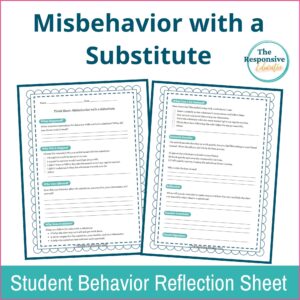
- Misbehaving With a Substitute Teacher
- Breaking Classroom Technology Rules
Each topic includes a two-page guided reflection process.
Two-Page Behavior Think Sheet Format
The first page helps students examine the incident by identifying what happened, why it happened, who was affected, and why the behavior created a concern.
The second page moves from reflection to instruction. Students identify what they can do instead, respond to a related scenario, and create a plan for handling a similar boundary or expectation more successfully.
Space is also included for:
- Scenario-based practice
- Student reflection and planning
- Teacher comments
- An optional parent or guardian signature
The behavior-specific format helps students identify a clear alternative response rather than writing a broad statement such as “I will follow the rules next time.”
Skills Students Practice
These behavior reflection worksheets and think sheets can help students practice:
- Asking permission before using materials or equipment
- Respecting other people’s belongings
- Recognizing personal-space boundaries
- Keeping hands and bodies appropriately positioned
- Following safety expectations
- Using restroom privileges responsibly
- Applying classroom expectations with different adults
- Using technology according to established rules
- Recognizing how boundary violations affect others
- Taking responsibility and planning a different response
The goal is not to teach students that every adult request or social preference is automatically a healthy boundary. Students should also learn that they may communicate discomfort, protect their own bodies and belongings, and seek help when someone else violates their boundaries.
Ways to Use These Behavior Reflection Sheets and Think Sheets
Use the sheets during:
- Individual behavior reflection
- Restorative conversations
- Classroom problem-solving
- Reteaching rules and boundaries
- SEL or social-skills instruction
- Behavior intervention planning
- MTSS or student-support meetings
- Parent-teacher conferences
- Home-school communication
- Reentry conversations after an incident
- Informal documentation of recurring concerns
Completed sheets may help teachers determine whether a student understands the rule, recognizes when it applies, and has the skills needed to follow it across adults and settings.
Look for the Skill Underneath the Boundary Concern
A student who gets too close to classmates may not recognize body-language cues. A student who uses materials without permission may not know how to ask or may struggle to wait. A student who has difficulty with a substitute may rely heavily on familiar routines or adult relationships.
Reflection should lead to instruction and problem-solving. Depending on the situation, useful supports might include:
- Explicitly teaching the rule and its purpose
- Modeling how to ask permission
- Practicing personal-space cues
- Using visual reminders
- Preteaching expectations before a substitute arrives
- Clarifying restroom routines
- Teaching appropriate technology use
- Reinforcing safe and respectful choices
- Providing supervised practice in the actual setting
- Teaching students how to communicate their own boundaries
These sheets should be completed after students are calm enough to think clearly. They do not replace direct teaching, supervision, accommodations, safety planning, or individualized behavior support when those are needed.
Build Understanding Alongside Accountability
Students need clear rules and boundaries, but they are more likely to apply them independently when they understand what the limit is, why it matters, and what they should do instead.
These respecting rules and boundaries behavior reflection sheets and behavior think sheets provide a structured way to teach that process while keeping reflection connected to the specific situation.
Need Think Sheets for Other Student Behaviors?
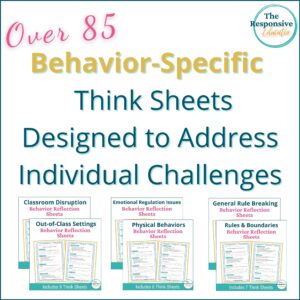
This individual think sheet is also included in the Student Behavior Reflection Sheets and Think Sheets Bundle. The complete bundle includes more than 85 behavior-specific reflection tools covering classroom disruptions, following directions, off-task behavior, emotional regulation, peer conflicts, honesty, rules and boundaries, physical behavior, transitions, self-monitoring, and behavior in out-of-class settings.
Choose the complete bundle if you need a coordinated collection of targeted think sheets for a wide range of classroom behavior concerns.
Reviews
There are no reviews yet.