You have been asked to collect ABC data for a student who is struggling. Someone gives you a form with sections for the antecedent, behavior, and consequence—but very little explanation about what the form is supposed to accomplish.
You may understand what the letters stand for and still wonder:
Those are reasonable questions. Teachers are often handed behavior forms without being shown how the information will help the student or support the team’s next decision. When that happens, an Antecedent Behavior Consequence Chart can feel like one more piece of paperwork added to an already full day.
Used thoughtfully, however, an ABC chart is much more than a record of what went wrong. It provides a consistent way to document what happened before, during, and after a behavior so that teachers and teams can begin looking beyond isolated incidents.
If antecedent, behavior, and consequence are still new terms for you, begin with ABC Behavior Explained: Understanding Antecedents, Behaviors, and Consequences. That article explains what each part means before you begin documenting it.
An Antecedent Behavior Consequence Chart is a structured tool for recording what happened immediately before a behavior, what the student did, and what happened immediately afterward. You may also hear it called:
The format may vary, but the basic purpose remains the same. The chart organizes observations using the three parts of the ABC model:
An ABC chart takes that framework and turns it into a practical observation tool.
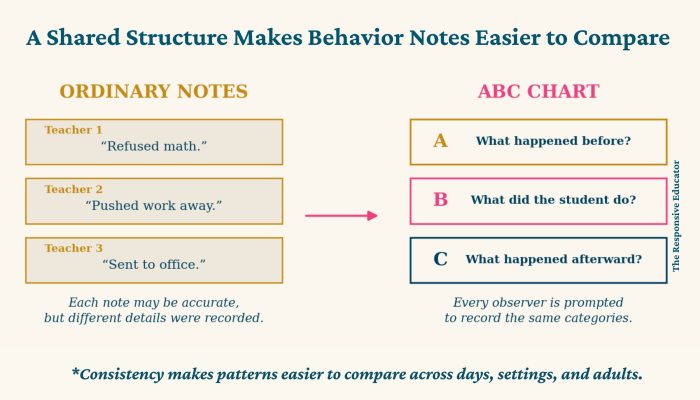
Teachers have always documented behavior through anecdotal notes, office referrals, parent communication logs, and incident reports. Those records may provide important information, but they do not always collect the same details consistently.
One teacher may focus on the student’s words. Another may describe the assignment. Someone else may document only the office referral or disciplinary response. Each account may be accurate, but comparing the incidents becomes difficult because each person recorded something different.
An Antecedent Behavior Consequence Chart gives observers the same basic structure. Each person records what happened before the behavior, the observable behavior, and what happened immediately afterward. Many forms also include the activity, setting, instructional format, duration, or student response.
That consistency matters because one difficult incident rarely explains a pattern. When observations are recorded using the same framework, the team has a better chance of comparing what happened across different days, activities, settings, and adults.
The chart is not valuable because it creates another record. It is valuable because it helps educators collect information in a way that can eventually be reviewed together.
Every ABC chart should include the antecedent, behavior, and consequence. Depending on the complexity of the concern and the questions the team is investigating, the chart may collect additional context as well. The goal is not to document every possible detail just for the sake of having it.
The antecedent section records what happened immediately before the behavior. This may include:
The antecedent should describe what occurred rather than explain why the student responded. For example, “The teacher directed the class to begin ten independent math problems” is an observation. “The student became angry because they hate math” assumes information the observer may not actually know.
The behavior section records what the student did in observable terms. Instead of writing, “The student was defiant,” record what another person could have seen or heard:
The student said, “I’m not doing this,” pushed the worksheet away, and put their head on the desk.
Clear descriptions make it easier for multiple adults to determine whether they are observing the same behavior. They also reduce the chance that the documentation will become a debate about whether the student was disrespectful, manipulative, unmotivated, or intentionally difficult.
Objectivity does not mean minimizing the behavior. It means describing it clearly enough that the team can discuss the same concern and measure whether it changes.
The consequence section records what happened immediately after the behavior. In ABC data, a consequence is not limited to punishment or discipline. It may include:
The immediate response is usually more important for ABC data than an outcome that occurred much later. An office referral or phone call home may need to be documented, but it may not be the first thing that happened after the behavior. The chart should capture that immediate response because repeated consequences may eventually help the team understand what continues to happen after similar behaviors.

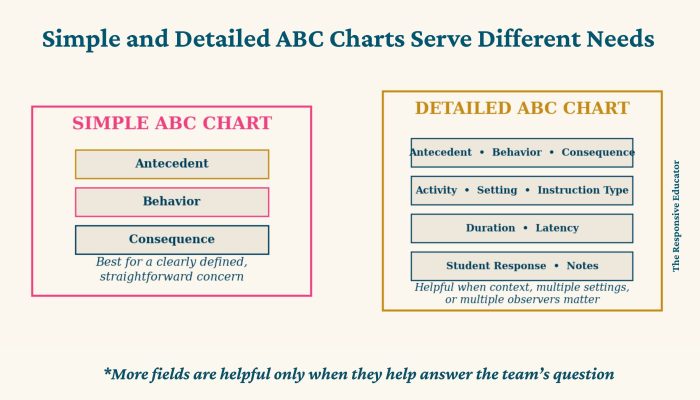
A simple ABC form may include only three open boxes. That may be enough for a straightforward observation or a limited concern.
More complex behavior often requires additional context. Depending on the student and the purpose of the observation, a more detailed chart may also include:
You do not necessarily need every category for every student. More fields do not automatically create better data. A form becomes useful when its categories prompt staff members to record details that help answer the team’s questions.
Imagine that a student repeatedly leaves their seat. Recording only “out of seat” confirms that the behavior occurred. Recording the activity and instructional format may reveal that it happens almost exclusively during independent writing and rarely during teacher-led instruction.
That additional context changes the questions the team may ask. Is the student having difficulty generating ideas? Does the assignment require skills the student has not mastered? Is independent task initiation difficult? Does the student need a clearer way to request help?
The chart does not answer those questions by itself. It helps the team identify which questions deserve further investigation.
Not all Antecedent Behavior Consequence Charts collect the same amount of information. That is not necessarily a problem because not every behavior requires the same level of investigation.
A basic ABC behavior chart may work well when:
A more detailed ABC chart may be helpful when:
I began using more detailed checklist-style forms because traditional narrative reports often left me with the same follow-up questions. I needed to know what activity was occurring, what type of instruction was being used, how long the behavior lasted, what adults did next, and how the student responded. The problem was not that teachers were unwilling to provide that information. Their forms had not prompted them to collect it while the incident was still fresh.
A detailed form should make meaningful documentation more manageable, not require teachers to write a longer story. Checklists, defined options, and a short notes section can help staff capture important context without stopping instruction to write several paragraphs.
Not every classroom behavior requires an ABC behavior chart. If a student calls out once during a lesson or has one unusually difficult afternoon, completing detailed ABC documentation may not be the best use of anyone’s time.
An Antecedent Behavior Consequence Chart becomes more useful when:
Think of the chart as an investigative tool. The more important the decision, the more important it becomes to collect information systematically instead of relying on memory or one especially memorable incident. Before beginning, ask:
How will this information help us make a better decision for this student?
If the form does not collect information that will help answer the team’s question, you may need a different form or a different type of behavior data.
ABC charts are not only for school psychologists or behavior specialists. Anyone who directly observes the behavior may be able to contribute useful information. Depending on the student and setting, observations may be completed by:
Collecting observations from more than one person can provide a broader picture of the student. A behavior may occur during math but not art, during independent work but not small-group instruction, or at school but rarely at home.
That does not mean everyone should collect data throughout the entire day. The team should decide which settings, activities, and observation periods are most likely to provide useful information. Clear definitions and brief training also help different observers record the behavior more consistently.

Paper and digital ABC charts can both work well. The better choice depends on where the behavior occurs, who is collecting the data, and how the information will eventually be reviewed.
A printed form can be easier to keep on a clipboard, in a data binder, or near the location where the behavior usually occurs. It allows staff members to record information quickly without locating a device or opening a program.
Paper may be especially practical when several adults need access to the same form or when technology is not readily available during instruction.
The limitation is that patterns can be difficult to recognize when the information remains spread across a stack of individual forms. The team eventually needs a way to organize and summarize those observations.
A digital form can make information easier to store, share, sort, and review. It may also reduce repeated data entry when observations feed directly into a spreadsheet or graphing system.
Digital tools are not automatically better, however. A system with too many fields, complicated menus, or several required steps may be difficult to use during an actual behavior incident. Convenience for the person reviewing the data should not make collection unrealistic for the person standing in the classroom.
The best system is one staff members can use accurately and consistently.
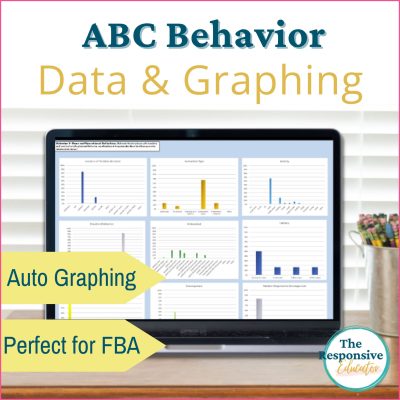
If you want a ready-to-use option, my ABC Data Sheet and Digital Graphing System includes printable and clickable incident reports along with an editable spreadsheet for organizing the information. The forms are designed to help staff capture important context through checklists and short notes rather than requiring a lengthy narrative for every incident.
A behavior checklist generally records whether particular behaviors occurred. It may allow the observer to check items such as refusal, aggression, elopement, disruption, or inappropriate vocalizations.
An Antecedent Behavior Consequence Chart may include a behavior checklist, but it also records the context surrounding those behaviors. It connects the observed behavior to what happened immediately before and afterward.
That distinction is important. A checklist might show that refusal occurred five times. An ABC chart may reveal that all five incidents occurred during independent writing and were followed by individual adult assistance. Both forms provide useful information, but they answer different questions.
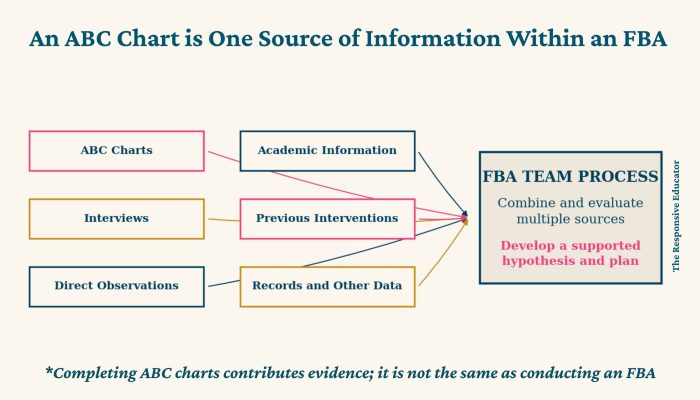
Many educators first encounter an Antecedent Behavior Consequence Chart when they are asked to collect information for a Functional Behavior Assessment. This sometimes leads people to believe that completing ABC charts is the same as conducting an FBA.
It is not.
An ABC behavior chart is one potential source of information within a larger assessment process. A comprehensive FBA may also include:
Each source provides a different piece of information. ABC charts help organize what happened before, during, and after individual incidents. Interviews may reveal patterns across settings or over a longer period. Academic data may show that the student lacks a skill required by the task that regularly precedes the behavior.
Teachers may be asked to complete ABC charts as part of an FBA, but they should not assume they are responsible for determining the function of behavior independently. The team combines ABC data with other relevant information to develop and evaluate a hypothesis.
An ABC behavior chart can document what happened. It cannot tell us with certainty what the student was thinking, feeling, or intending.
It also cannot establish the function of behavior from one observation. A completed chart may suggest questions worth investigating, but one incident is not enough to prove why a behavior occurred.
Suppose a student refuses an assignment and then receives one-on-one help. It may be tempting to conclude that the behavior occurred to obtain adult attention. The student may also lack the academic skills needed to complete the assignment, have difficulty organizing how to begin, or need a more appropriate way to request assistance.
The chart gives the team evidence to consider. It does not make the final decision for them.
One completed Antecedent Behavior Consequence Chart tells you what happened during one incident. Multiple charts allow the team to begin looking for information that repeats across observations.
This post stops at the collection stage. The next two articles will address what teachers and teams do with the information:
An ABC Behavior Chart is not valuable simply because every section has been completed. Its value comes from helping teachers and teams collect consistent, objective information they can use to understand a student more fully.
A useful chart identifies what happened before the behavior, describes what the student actually did, and records what happened immediately afterward. When additional context is relevant, it may also capture the activity, setting, instruction type, duration, latency, or student response.
The goal is not to create more paperwork or document every difficult moment. It is to gather the information that helps the team ask better questions, identify missing skills, examine conditions adults may be able to change, and make more thoughtful decisions about the support a student needs.


Support your students’ individual needs with our exclusive Classroom Concerns Checklist.
Identify key concerns in areas like cognitive skills, communication, social/emotional behavior, and more.
Sign up now to receive instant access and valuable insights on addressing classroom concerns.
Don’t miss out, join our community today!

Support your students’ individual needs with our exclusive Classroom Concerns Checklist.
Identify key concerns in areas like:
…and more to help drive collaboration and problem-solving.
Sign up now to receive instant access and valuable insights on addressing classroom concerns.