Have you ever looked at behavior data and thought, “Those numbers don’t seem nearly as serious as this behavior feels?”
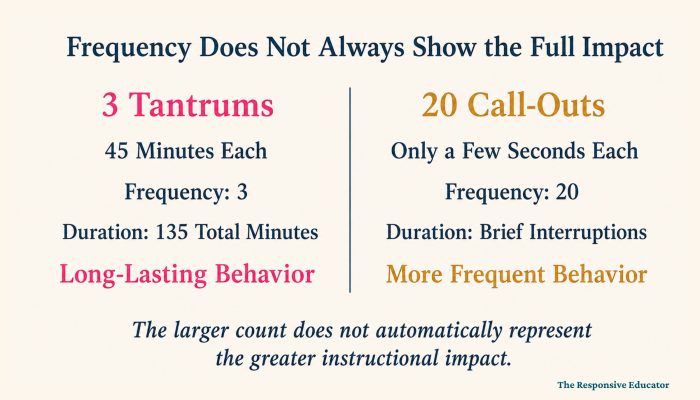
Imagine a student who has three tantrums over the course of a week. At first glance, three incidents may not sound especially concerning. Then you discover that each tantrum lasted approximately 45 minutes. Suddenly, those three tally marks tell a very different story.
Now imagine another student who calls out 20 times during a lesson. The behavior occurs more frequently, but each interruption lasts only a few seconds. Which behavior had the greater effect on instruction?
That is one limitation of frequency count. Frequency tells you how many times a behavior occurred, but it does not tell you how much of the school day the behavior consumed. Sometimes, the length of the behavior is the information teachers, families, administrators, and IEP teams most need to understand.
Duration count answers a different question. Instead of asking, “How many times did it happen?” duration asks, “How long did it last?”
For behaviors such as tantrums, crying, extended work refusal, time spent outside the assigned area, or being off task, measuring duration may provide a more accurate picture of what is happening. It can show how much instructional time the student is missing, how long adult support is required, and whether an intervention is producing meaningful change.
One question I often ask is:
Would someone naturally ask, “How long has this been going on?”
If the answer is yes, duration count is worth considering. Another clue is when a teacher asks, “How much of my day am I spending responding to this behavior?” Both are questions about time rather than frequency.
This article assumes you have already learned how to define an observable behavior and collect baseline data. If you are still deciding whether to use frequency, rate, duration, interval recording, or another measurement method, begin with Behavior Data Collection: How to Choose the Right Measurement Method. If you are wondering whether counting each occurrence would answer your question more effectively, read Frequency Count: When Is It the Right Choice?
Not every challenging behavior happens frequently. Some behaviors occur only once or twice a day but consume a significant amount of instructional time.
Consider a student who cries for an hour after being asked to complete independent work. Another student may refuse to begin an assignment for 30 minutes. A third student may spend 45 minutes wandering around the classroom instead of participating in instruction. None of these behaviors may happen many times, but their effect continues for every minute they last.
The student loses access to instruction. The teacher’s attention is divided, other students may be distracted, and additional staff may be needed to maintain safety or help the student return to learning. A frequency count of one does not communicate any of that.
Duration count documents how much time the behavior occupied. That information can help an IEP team evaluate whether an intervention is working, demonstrate the level of support a student requires, and determine whether the student is regaining access to instruction more quickly.
Duration does not measure every part of the behavior’s impact. However, it gives the team objective information about time that a frequency count alone cannot provide.
Duration count is most useful when the length of the behavior matters more than the number of times it begins.
Think back to the students in the introduction. One student had three 45-minute tantrums. The other called out 20 times during a lesson. If you looked only at frequency, you might assume the student who called out required more support because that behavior occurred more often. Once you consider the amount of instructional time involved, the three tantrums become much more significant.
That is why choosing the right behavior measurement method matters. The best method is not always the easiest one to collect. It is the one that answers the question you are actually asking and communicates what happened accurately.
Duration count may be appropriate for behaviors such as:
The behavior still needs to be defined carefully. “Work refusal,” for example, could refer to the time between a clear direction and the student beginning the task. “Elopement” could be measured by counting each time the student leaves an assigned area or by measuring how long the student remains outside that area. The correct method depends on what the team needs to understand.
Behaviors such as calling out, hitting, swearing, raising a hand, or throwing an object are often better suited to frequency count because each occurrence is brief and can be counted reliably. However, even those behaviors may sometimes be measured with duration when they occur as part of a longer episode. The behavior itself does not automatically determine the method; the question you are trying to answer does.
A useful guideline is:
If the behavior is best described by asking, “How long did it last?” duration count is probably the better choice.
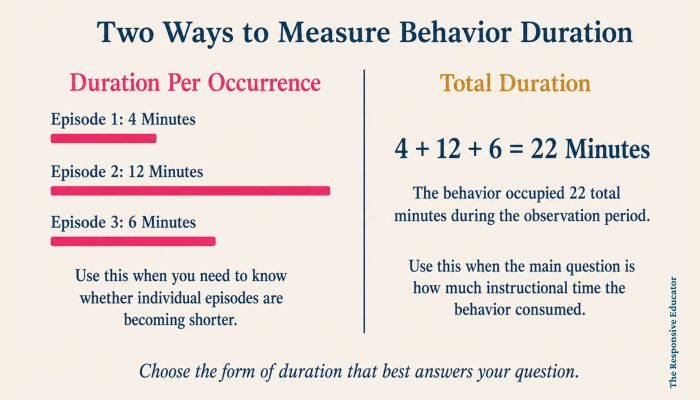
Duration data can be collected in more than one way. Before starting, decide whether you need the length of each individual occurrence or the total amount of time the behavior occupied during an observation period.
Duration per occurrence measures how long each separate episode lasts. If a student has three episodes of crying, you might record that the first lasted four minutes, the second lasted 12 minutes, and the third lasted six minutes.
This approach is useful when you want to know whether individual episodes are becoming shorter. A student may continue to have several episodes each week, but decreasing from 45-minute episodes to 10-minute episodes would represent meaningful progress.
Total duration combines all occurrences during the observation period. If the same student cried for four, 12, and six minutes, the total duration would be 22 minutes.
This measurement is useful when the main question is how much instructional time the behavior consumes. It may also be easier to communicate when several shorter episodes occur throughout the day.
Neither method is automatically better. Choose the one that best answers your question, record which form of duration you are using, and apply it consistently across observations.
Using a stopwatch is the easy part. The difficult part is deciding exactly when the timer starts and stops.
Without clear definitions, two adults watching the same student may record very different duration data because they interpret the behavior differently. This is particularly likely with broad terms such as tantrum, refusal, escalation, or off-task behavior.
Imagine that you are measuring the duration of a tantrum. Does it begin when the student first refuses, raises their voice, throws an object, or drops to the floor? When does it end? If the student stops screaming for 30 seconds and then starts again, was the tantrum over, or was that only a brief pause?
There is not one universal answer that works for every student and every behavior. A team might decide that any pause lasting longer than 30 seconds marks the end of one occurrence and the beginning of another. Another team may decide that the episode continues until the student has remained calm and returned to an expected activity for two minutes.
Either approach can work if it matches the team’s purpose and everyone follows it consistently.
If one adult stops the timer after a 30-second pause while another continues timing, the team will end up with two different data sets describing similar events. That makes it difficult to compare observations or determine whether the student’s behavior has actually changed.
The goal is for different adults observing the same event to collect reasonably similar data. In behavior measurement, this is called interobserver agreement. Clear operational definitions and consistent start-and-stop rules improve that agreement and make the data more trustworthy.
Before collecting duration data, define:
That consistency matters more than the particular stopwatch or timer you use.
After a difficult morning, it is easy to say, “He screamed all morning,” or “She cried all day.” Those statements may accurately describe how the experience felt, but they do not provide information that can be measured or compared.
Duration count replaces those impressions with objective data. Instead of saying that a student cried all morning, you may discover that the crying lasted 38 minutes. Instead of reporting that a student refused to work for the entire math block, you may find that the student refused for 18 minutes before beginning the assignment independently.
That does not minimize the difficulty of the behavior. Eighteen minutes of refusal may still significantly affect the student’s learning and require substantial teacher support. The purpose of collecting the data is not to prove that the teacher’s experience was wrong. It is to describe what happened clearly enough that the team can evaluate change.
Objective duration data is easier to communicate to families, administrators, and IEP teams. More importantly, it gives you something specific to compare across time. “It felt better this week” becomes “The average duration decreased from 32 minutes to 14 minutes.”
One of the most memorable examples from my career involved a kindergarten student who had learned that sufficiently severe behavior often resulted in being sent home early. She did not want to remain at school, so escalation helped her escape the school day. Each time she was sent home, that outcome made the same behavior more likely to work again.
This is a situation in which I have tremendous empathy for classroom teachers and administrators. Schools are increasingly expected to support students with significant behavioral and mental health needs, often without adequate staffing, training, or access to outside services. At the same time, the student needs effective support, and the rest of the class deserves a safe environment in which to learn.
In this case, I was working as a behavior specialist in a highly staffed alternative program. We had trained adults, an individualized plan, space to maintain safety, and the ability to provide continuous support. This was not a decision that a classroom teacher should attempt alone or a general recommendation to keep every student at school regardless of safety.
After talking with the student’s mother, we agreed that continuing to send her home was unlikely to help her develop the skills she needed to remain at school successfully. I explained that changing the outcome might initially lead to more intense or longer behavior because the response that had worked previously would no longer produce the same result.

I also explained the change to the student in language she could understand. Going home early was no longer the automatic outcome. If she became upset, we would help her remain safe, work through the episode, and return to the school routine when she was ready.
As expected, the behavior escalated dramatically. She screamed, threatened staff, removed her clothing, urinated, and attempted to hit and scratch adults. Two trained female staff members remained with her throughout each episode, maintained safety, offered choices when appropriate, and followed the individualized plan consistently.
The first few days were extremely difficult. Some people questioned whether the intervention was working because the episodes lasted longer than they had before. That was exactly why duration data was so valuable.
We continued measuring how long the behavior lasted each day and marked the beginning of the new intervention with a phase line on the graph. The duration increased sharply for several days and then decreased dramatically. Once leaving school was no longer the predictable outcome, the behavior stopped accomplishing the same purpose.
If we had relied on memory or stopped after the first difficult day, we might have concluded that the intervention had failed. The duration data showed an initial increase followed by a significant decrease. That pattern helped the team continue an appropriately supported plan that ultimately allowed the student to become more successful at school.
This example does not mean that every escalation should be handled in the same way. Decisions involving serious behavior must account for safety, staffing, the student’s individual needs, and the function of the behavior. The lesson is that accurate data can help a trained team distinguish between a short-term increase and a plan that is not working.
Sometimes the most important information is not how often a behavior happens. It is how much of the school day the behavior consumes and how much support is required while it is happening.
I once worked with a student whose aggressive behavior required two to four adults to remain with him for extended periods to maintain safety. We were not simply documenting that aggression occurred. We needed to demonstrate the level of support required during those episodes.
Frequency data alone did not accomplish that. Whether the student engaged in five or 10 individual acts of aggression did not communicate how long staff had to manage unsafe behavior.
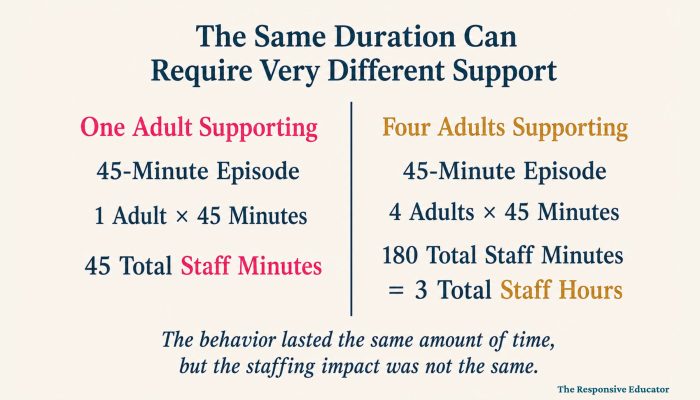
We recorded the duration of each episode and the number of adults involved. A 45-minute episode requiring one adult is very different from a 45-minute episode requiring four adults. The duration is the same, but the staffing impact is not.
In some cases, it may be useful to calculate total staff time. If four adults provide support for 45 minutes, that represents three total staff hours. That information can help administrators and IEP teams understand why current staffing is insufficient or why additional services are being requested.
This is also a reminder that one measurement method may not tell the entire story. Duration captures time, while frequency captures occurrences. Staffing records, ABC data, academic information, and safety documentation may provide other parts of the picture. Collect additional information when it answers a meaningful question, not simply because more data seems better.
Just because a behavior can be timed does not mean duration is the most useful measurement. The goal is not to collect every possible type of data. It is to collect the information that best answers your question.
Some behaviors do not last long enough for duration to provide meaningful information. You could technically measure how long a student keeps their hand raised, but that probably would not tell you what you need to know. If the question is how often the student participates, frequency count would be more useful.
The same is often true for brief behaviors such as calling out, hitting, throwing objects, swearing, or asking for help. These occur as individual events that can usually be counted reliably. Measuring the number of seconds each occurrence lasts may add work without adding useful information.
Duration may also be difficult to collect accurately when a teacher cannot watch the behavior continuously. If you miss the beginning or end, the recorded time becomes an estimate. In that situation, interval recording or another measurement method may be more realistic.
One reason behavior data collection can feel confusing is that the same broad behavior may be measured using different methods. The best choice depends on what you are trying to learn.
Take aggression as an example. If a student occasionally hits another student during transitions, you may want to know how many times the aggression occurs. Frequency count would probably answer that question well.
Now imagine a student who spends 45 minutes attempting to hit, kick, spit at, or chase staff members. Counting every attempt may be impractical and may not communicate the full impact of the episode. The more important question becomes, “How long did the unsafe behavior continue before the student was able to return safely to instruction?” That is a duration question.
Neither method is inherently wrong. They answer different questions. Before deciding what to measure, identify what the data needs to communicate.
Collecting duration data does not require expensive equipment. A phone stopwatch, digital timer, smartwatch, or classroom timer can all work. Choose a tool you can access quickly without interrupting instruction or drawing unnecessary attention to the observation.
The specific tool matters less than the consistency of the system. If you are constantly searching for a timer or trying to reconstruct when the behavior began, the data will not be accurate. A simple tool that you will actually use is more valuable than a complicated one that remains in a drawer.
You also need a practical place to record the behavior, start time, end time, and total duration. If several adults collect data, make sure everyone knows where the form and timer are kept and how the information should be recorded.
*This section contains affiliate links. If you purchase through one of these links, I may earn a small commission at no additional cost to you.
You may already have everything you need on your phone or smartwatch. However, some teachers prefer a separate timer that can remain with the data sheet or observation clipboard. These are a few options that can make starting and stopping the timer easier during a real classroom day.
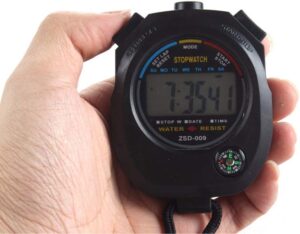
A traditional stopwatch is a simple choice when you want a device that is easy to grab and does not require opening an app. [This stopwatch] can remain with your data collection materials and can also be used during recess, physical education, field trips, or other settings outside the classroom.
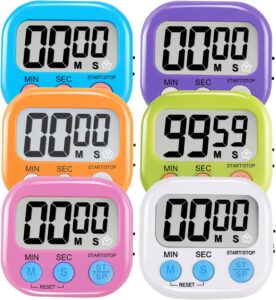
Small digital classroom timers may work well when several staff members collect data or when you want to keep timers in different locations. [These colorful timers] can be assigned to particular classrooms, students, or data clipboards so staff are not searching for a timing tool when an observation begins. Make sure the timer you select can count elapsed time and allows you to start and stop it quickly.
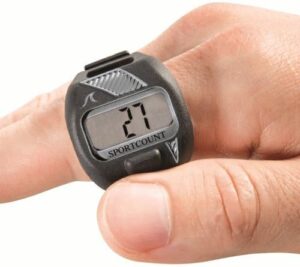
A wearable finger stopwatch provides a more discreet option when you need your hands available for instruction or student support. [This compact stopwatch] can be worn on one finger and operated without holding a phone or larger timer, which may make it practical during active classroom routines or community-based instruction.
Whatever tool you select, practice using it before beginning formal data collection. The goal is to make timing the behavior quick and routine so your attention can remain on instruction, safety, and the student.
Many teachers begin with a timer and a sheet of paper, only to find themselves spending additional hours creating spreadsheets, calculating totals, and preparing graphs for meetings. Building those systems yourself is certainly possible, but it is not always the best use of limited planning time.
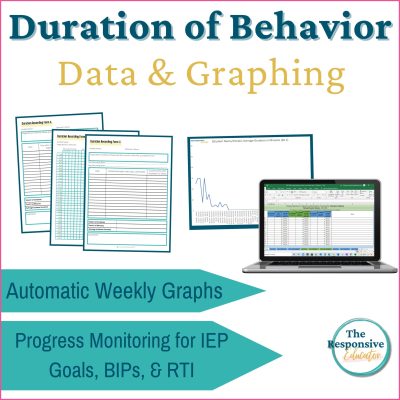
That is why I created my Duration Recording Forms and Graphing System. It includes editable duration recording forms, automatic graphing in Excel and Google Sheets, step-by-step directions, and example graphs. The forms organize the information so teachers can spend more time interpreting the data and less time formatting spreadsheets.
The resource does not decide what the behavior means or which intervention the student needs. Your observations, knowledge of the student, and professional judgment remain essential. The system simply makes the repetitive parts of collecting and graphing duration data more manageable.
Once you have collected duration data across several days or weeks, step back and look for patterns. One particularly good or difficult day rarely provides enough information to evaluate an intervention.
Ask whether the behavior is generally lasting longer or becoming shorter. Did the duration change after a new intervention began? Did episodes become longer after returning from a school break? Are certain subjects, settings, or times of day associated with longer behavior?
Graphing the data makes these patterns easier to recognize. A graph will not tell you why the duration changed, but it can show when the change occurred. That information helps you ask better questions, evaluate whether the intervention is moving in the intended direction, and communicate progress more clearly.
If duration is consistently longer during one task or setting, consider what else may be happening. Is the task too difficult? Does the student lack an effective way to ask for a break or assistance? Are adult responses unintentionally allowing the student to avoid the task for longer periods? Duration data identifies the pattern, while observations and ABC data help the team investigate the reasons underneath it.
Even experienced educators sometimes collect duration data in ways that make it difficult to interpret. Most of these problems can be prevented by agreeing on the procedure before data collection begins.
If adults disagree about what the behavior includes, they will collect different data. Before anyone starts a timer, make sure the behavior is observable and clearly defined. Avoid broad descriptions such as “upset,” “uncooperative,” or “out of control” unless the specific actions included in those terms are explained.
One adult may begin timing when a student raises their voice, while another waits until the student begins screaming. One may stop after a brief pause, while another continues until the student has returned to an assigned activity.
Neither procedure is automatically correct. The problem occurs when different adults use different rules. Consistent start-and-stop procedures improve interobserver agreement and make it more likely that changes in the data reflect changes in the student’s behavior rather than differences in how adults measured it.
If a behavior occurs quickly and repeatedly, duration may not provide meaningful information. Ask whether you need to know how often the behavior occurs or how long it lasts. The answer usually points toward the better measurement method.
Statements such as “He screamed all morning,” “She cried forever,” or “He was off task all day” may describe how the day felt, but they cannot be compared reliably. Start the timer when the behavior begins and record the actual duration whenever possible.
A 20-minute episode during a 30-minute lesson and a 20-minute episode during a six-hour school day have different instructional effects. Duration tells you how long the behavior lasted, but the surrounding context still matters. Record major schedule changes, shortened observation periods, interventions, or other events that may affect how the data should be interpreted.
Duration count gives us something frequency alone cannot: a picture of how much time a behavior occupies. A behavior that occurs only once or twice a day may still require hours of staff support, significantly reduce instructional time, or interfere with a student’s ability to participate in learning.
Like every behavior measurement method, duration count is a tool. Its value depends on choosing it for the right question, defining the behavior clearly, collecting the data consistently, and using the information to guide thoughtful decisions.
The goal is not simply to make an episode shorter. We need to understand what is contributing to the behavior, teach the student more effective ways to communicate or regulate, and adjust the environment and adult responses when needed. Duration data helps us determine whether those supports are helping the student return to safety, instruction, and independence more successfully.
If you are ready to turn the data into a visual pattern, continue to Duration Graph: How to Graph and Interpret Behavior Data. The next post explains how to graph duration, recognize meaningful trends, and use the information without allowing one unusually difficult day to determine the entire plan.