One of the most common questions I hear from teachers is, “What kind of behavior data should I collect?” It’s a great question, but the answer often surprises people. There isn’t one “best” way to approach behavior data collection because different behaviors require different types of measurement. The best measurement method is simply the one that helps you collect data that accurately represents what is actually happening.
Over the years, I’ve worked with teachers who carefully collected weeks of behavior data, only to discover that the information didn’t answer the question we were trying to answer. Sometimes they counted the number of times a behavior occurred when the real concern was how long it lasted. Other times they tracked frequency when what really mattered was the intensity of the behavior or the amount of support it required from staff. The data itself wasn’t wrong, but it wasn’t giving the team a complete picture of the student’s needs.
I remember working with one student whose unsafe behaviors often required multiple adults to safely support him. If I had simply recorded that he engaged in aggression four times during the day, the data would have missed the most important part of the story. Those four incidents often required two to four adults at a time and could last for extended periods. Simply counting the number of incidents didn’t communicate the amount of instructional time that was being lost or why additional support was necessary.
The opposite can happen as well. Imagine reading that a student had three tantrums during the course of a week. At first glance, that might not sound especially concerning. However, if each tantrum lasted forty-five minutes, you’ve suddenly lost more than two hours of instructional time in a single week. Frequency alone doesn’t tell that story. Duration does.
That’s why choosing the right behavior measurement method is such an important part of behavior data collection. The goal isn’t simply to collect behavior data. It’s to collect data that paints an accurate picture of what is happening. Once you have that accurate picture, you’re in a much better position to identify patterns, select appropriate interventions, monitor progress, communicate effectively with your team, and advocate for the support a student truly needs.
In this guide, you’ll learn what each behavior measurement method is designed to measure, when it works best, and how to choose the one that will give you the clearest picture of the behavior you’re trying to understand.
Before you decide how to collect behavior data, you first need to know exactly what behavior you’re measuring. If you haven’t already established a clear behavioral baseline and operationally defined the target behavior, I recommend starting with my article on Behavioral Baseline Data. That article walks through identifying the target behavior, writing clear operational definitions, and determining what information you already have before deciding how to measure it.

One of the biggest mistakes I see teachers make is choosing the same type of behavior data for every behavior. Frequency recording is often the first method people learn, so it becomes the default. Other teams rely heavily on interval recording because that’s what they’ve always used. The reality is that every measurement method has strengths and limitations, and choosing the right one depends entirely on the behavior you’re trying to understand.
Before selecting a data sheet, ask yourself a simple question:
What do I want to know about this behavior?
Do you want to know how often it happens? How long it lasts? Does it happen too frequently to count every occurrence? Are your observations different lengths? Or are you trying to understand why the behavior keeps happening?
Once you know which question you’re trying to answer, choosing the right measurement method becomes much easier.
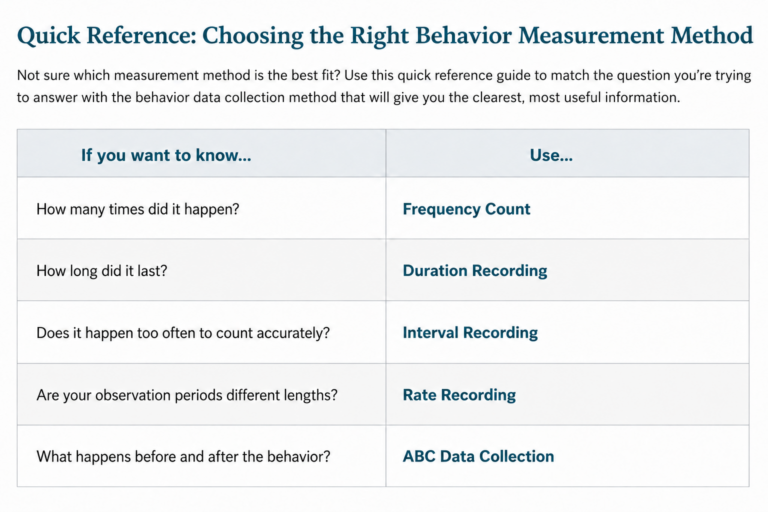
Frequency recording, sometimes called event recording, measures the number of times a behavior occurs. It works best when the behavior has a clear beginning and end, making each occurrence easy to identify and count.
Frequency recording is often a good choice for behaviors such as:
If you can clearly point to an occurrence and say, “That happened once,” frequency recording is probably a good option.
However, frequency doesn’t always tell the whole story. Imagine recording that a student had three tantrums during the week. That sounds very different than learning those three tantrums lasted forty-five minutes each. Likewise, recording that a student engaged in aggression four times during the day doesn’t communicate that each incident required several adults to safely manage the situation. In both examples, the frequency data is accurate—but it doesn’t paint a complete picture of what was happening.
Want to learn more? Read my complete guide to Frequency Recording to learn when to use it, common mistakes to avoid, and how to collect reliable frequency data in the classroom.
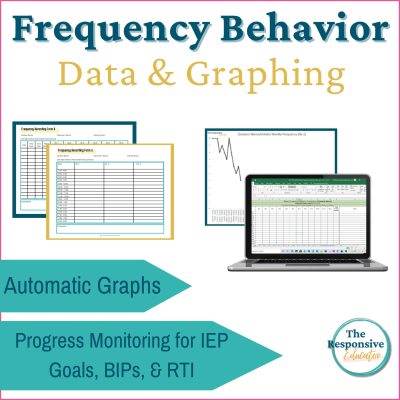
My Frequency Behavior Data + Graphing resource includes printable data sheets plus automatic Excel graphs that update as you enter your data, making progress monitoring much faster. It is available individually or as part of my complete Behavior Data Collection Bundle.
Duration recording measures the amount of time a behavior lasts from beginning to end. This method is most useful when the length of the behavior is more important than the number of times it occurs.
Duration recording works well for behaviors such as:
Think back to the student who experienced three tantrums during the week. Frequency tells us there were three incidents. Duration tells us those three incidents lasted more than two hours altogether. Those two pieces of information create very different pictures of the student’s day and often lead to very different decisions about support.
Whenever you find yourself saying, “The number of times isn’t really the issue—the behavior just lasts a long time,” duration recording is usually the better choice.
Want to learn more? Read my complete guide to Duration Recording to learn when to use it, how to calculate duration accurately, and common mistakes to avoid.
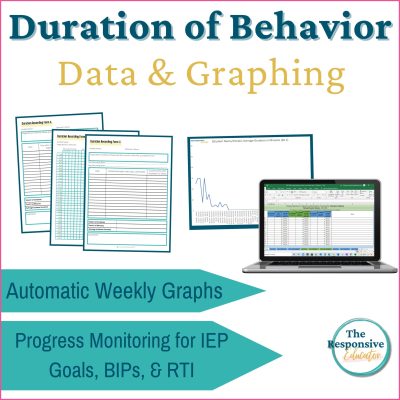
Looking for a duration recording data sheet? My editable Duration Behavior Data + Graphing resource includes printable data sheets plus automatic Excel graphs that update as you enter your data, making progress monitoring much faster. It is available individually or as part of my complete Behavior Data Collection Bundle.
Some behaviors occur so frequently that counting every occurrence simply isn’t realistic while you’re also teaching a classroom full of students. Interval recording provides a practical way to estimate how often those behaviors occur without requiring you to continuously watch and count every occurrence.
Instead of counting individual behaviors, interval recording divides an observation period into equal intervals. During each interval, you simply record whether the behavior occurred. This allows you to identify patterns and monitor changes over time without the demands of continuous counting.
Interval recording is often a good choice for behaviors such as:
Because interval recording estimates rather than counts exact occurrences, it isn’t the best choice when you need a precise number of behaviors. However, it’s an excellent option when continuous counting isn’t practical.
Want to learn more? Read my complete guide to Interval Recording to learn the differences between whole interval, partial interval, and momentary time sampling.
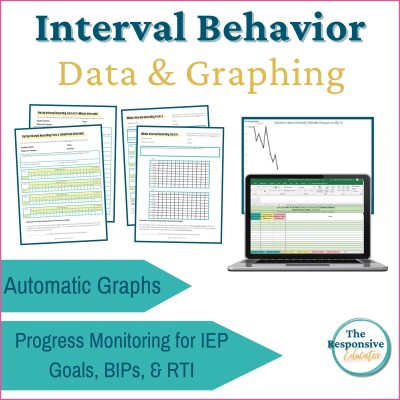
Need an interval recording data sheet? My Interval Behavior Data + Graphing resource includes printable data sheets plus automatic Excel graphs that update as you enter your data, making progress monitoring much faster. It is available individually or as part of my complete Behavior Data Collection Bundle.
Rate recording is similar to frequency recording because you’re still counting how many times a behavior occurs. The difference is that rate also considers how much time you spent observing. This allows you to fairly compare observations that lasted different amounts of time.
Most classroom teachers won’t need rate recording every day. It becomes especially useful when observation periods vary from one day to the next or when different staff members observe a student for different amounts of time.
Because both methods involve counting behaviors, teachers sometimes assume that frequency and rate recording are interchangeable. They aren’t.
Frequency simply tells you how many times a behavior occurred during your observation. Rate tells you how often the behavior occurred based on the amount of time you observed.
Imagine you observe a student for thirty minutes on Monday and one hour on Tuesday. During both observations, the student calls out six times. If you only look at frequency, the data appears exactly the same because the student called out six times during each observation. However, rate tells a different story. On Tuesday, the student called out at only half the rate because the same number of behaviors occurred over twice as much observation time.
Whenever your observation periods aren’t consistent, rate provides a much more meaningful comparison than frequency alone. If every observation lasts the same amount of time, frequency is usually all you need.
Want to learn more? Read my complete guide to Rate Recording to learn when rate provides a clearer picture than frequency data.
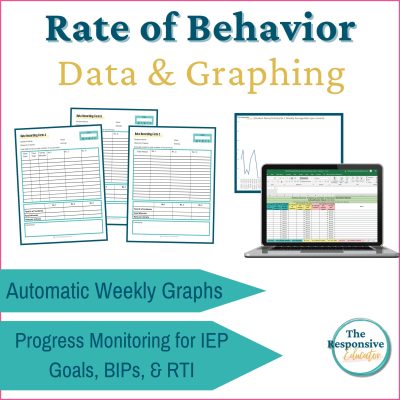
Looking for a rate recording data sheet? My Rate Behavior Data + Graphing resource includes printable data sheets plus automatic Excel graphs that update as you enter your data, making progress monitoring much faster. This resource is available individually or as part of my complete Behavior Data Collection Bundle.
The previous measurement methods answer questions like how often, how long, or how frequently a behavior occurs. ABC data answers a different question. Instead of focusing on the amount of behavior, it helps you understand what happened immediately before and immediately after the behavior occurred.
ABC stands for Antecedent, Behavior, and Consequence. By documenting those three pieces of information over multiple observations, patterns often begin to emerge that aren’t obvious from frequency or duration data alone.
ABC data is often the best choice when:
Want to learn more? Read my complete guides to ABC Data Collection and the ABC Model of Behavior to learn how to identify patterns and better understand student behavior.
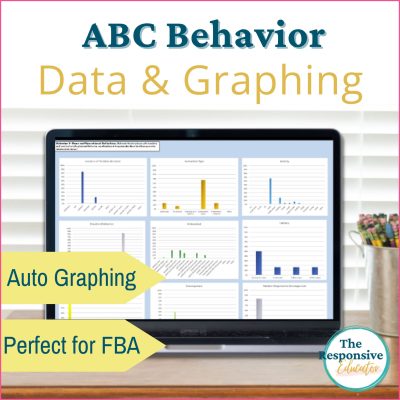
Need an ABC data sheet? My editable ABC Data Collection + Automatic Graphing forms make it easy to document antecedents, behaviors, and consequences while automatically graphing patterns over time. If you’re building a complete behavior assessment system, these forms are also included in my Functional Behavior Assessment (FBA) Bundle.
Every behavior doesn’t need to be measured the same way. The best measurement method is the one that answers the question you’re trying to answer and paints the most accurate picture of what is happening.
The goal isn’t simply to collect behavior data. It’s to collect data that paints an accurate picture of what is happening. When your data accurately reflects what students are experiencing, you’re in a much better position to teach the skills they need, evaluate whether your interventions are working, and make decisions based on evidence instead of assumptions.
In the next article, we’ll take a much deeper look at Frequency Recording—when it’s the right choice, common mistakes to avoid, and how to collect accurate frequency data in your classroom.


Support your students’ individual needs with our exclusive Classroom Concerns Checklist.
Identify key concerns in areas like cognitive skills, communication, social/emotional behavior, and more.
Sign up now to receive instant access and valuable insights on addressing classroom concerns.
Don’t miss out, join our community today!

Support your students’ individual needs with our exclusive Classroom Concerns Checklist.
Identify key concerns in areas like:
…and more to help drive collaboration and problem-solving.
Sign up now to receive instant access and valuable insights on addressing classroom concerns.